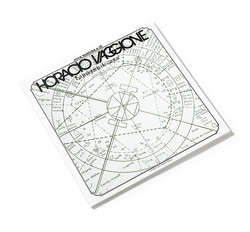
Fluides presents five electroacoustic works by Horacio Vaggione, ordered from the newest (2015) back to the oldest (1984), all finalized in stereo in his studio in August 2017. The first four start from acoustic material treated according to what he calls his “mutational” preferences; the last was made with frequency modulation synthesis, but its “multi-scale” granular approach links it to the others.
Mécanique des fluides (2014-15), commissioned by the French State and the Ina-GRM, starts from Vaggione's view that all sounds behave like fluids, laminar or turbulent, without trying to imitate nature. PianoHertz (2012) was made at the ZKM in Karlsruhe for its 46-channel Klangdom from short piano sounds the composer played himself, extended through granulation, micro-editing and convolution into an “acousmatic consort”. Its ancestor, Consort for Convolved Violins (2011), applies the same convolution techniques to figures played by Wen Chen, David Brown and Manfred Kraemer, and is dedicated to the memory of Max Mathews.
Préludes suspendus III (2009-10), made at the IMEB in Bourges, belongs to a decade-long series testing a shared palette of sound materials, some of which later fed Mécanique des fluides and PianoHertz; it shared the Prix Ton Bruynèl in 2010. Fractal C (1983-84) was realized at Ircam on a VAX 780 in the Cmusic language, using the triadic Cantor set as a generative model across many time scales. The code no longer runs; the music remains.
Born in Córdoba, Argentina, in 1943, Vaggione studied with Juan Carlos Paz, was introduced to the computer by Lejaren Hiller and Herbert Brün in Illinois, and worked with Luis de Pablo at the Alea studio in Madrid. Living in France since 1978, he taught at Université Paris 8 from 1989.
CD in OGpak, empreintes DIGITALes IMED 17145, 2017.