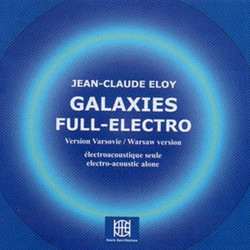
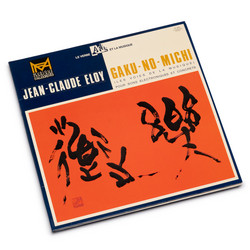
Jean-Claude Eloy
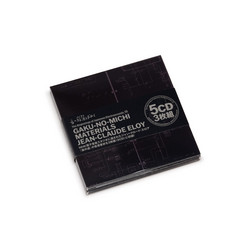
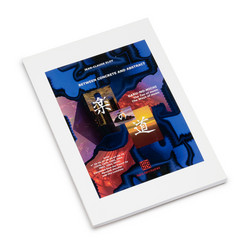
Gaku-No-Michi (4CD Box)
A work of genuinely monumental proportions. Jean-Claude Eloy's Gaku-No-Michi - subtitled "Tao of Music" or "Ways of Music" - stands among the towering achievements of 20th Century electroacoustic practice. Produced at the electronic music studio of NHK Radio in Tokyo between 1977 and 1978, its four hours of concrete and electronic sound unfold as what the composer called "a film without images" - an immense, spiraling architecture of sonic transformation that remains, nearly five decades on, as radical and absorbing as the day it was conceived.
Born in Paris in 1938, Eloy belonged to the great second wave of post-war European composers. He studied at the Conservatoire National Supérieur, winning First Prizes in Piano, Chamber Music, Counterpoint, and Ondes Martenot, and worked on composition with Darius Milhaud. Summer courses at Darmstadt brought encounters with Messiaen, Boulez, and Stockhausen; he then entered Boulez's master class at the Music Academy in Basel. Yet Eloy was never content to remain within the European serialist orbit. A professorship at the University of California, Berkeley during the late 1960s opened his ears to Eastern aesthetics - to the vast, unhurried perception of time in Asian musical traditions. From that point forward, his trajectory diverged sharply from his contemporaries, carrying him toward India, Japan, and a singular practice in which the boundaries between Occident and Orient dissolved into sound itself.
After the 135-minute electronic meditation of Shânti (1972-74), realized in Cologne, Eloy traveled to Tokyo. There, working inside the NHK Denshi Ongaku Studio, he produced Gaku-No-Michi - a composition of staggering ambition, structured in four linked parts. The first, "Tokyo", draws on the raw acoustic fabric of the city - subway announcements, factory hum, political speeches broadcast from loudspeakers in public squares - and subjects it to a slow, spiraling metamorphosis, pulling the concrete toward the abstract. "Fushiki-e", the longest section at nearly 80 minutes, reverses the trajectory: electronically generated material absorbs fragments of Gagaku court music, Nô theater, and Shômyô Buddhist chant, drifting toward a sustained "sound of immobilization" - an immense organ point of contemplative stillness. "Banbutsu no Ryûdô" works an endlessly metamorphosing weft of daily and extraordinary sound, where a nationalistic speech dissolves into the buzzing of insects, where the hollow strike of a bamboo Shishi Odoshi against stone emerges only after long electronic transformation. "Kaiso", the final movement, condenses reminiscences of all that preceded, built around the annual commemorative ceremony of Hiroshima, leading through gravity and lament toward an infinitely sustained tone of peace.
What distinguishes Gaku-No-Michi from so much electroacoustic work of its era is the sheer physical presence of its sound world. Eloy does not merely manipulate material - he inhabits it. The timbral palette is extraordinarily rich: electronically fabricated Tibetan bells more haunting than their acoustic counterparts, iridescent spirals that diffract into divergent lines before converging into vast harmonic masses, crackling meteorite trails, low-pitched resonances swept by winds both violent and majestic. The experience of duration is central to the work's design. Four hours is not a provocation but a necessity - the time required for the listener's perception to shift, for ordinary awareness of passing minutes to give way to something closer to immersion, to what Eloy described as a "psychophysical acoustic" encounter with sound.
This 4CD set on Hors Territories represents the first complete publication of the work in its digitalized and revised version, dedicated to the memory of Wataru Uenami. Packaged in a 10-panel digipak with a 16-page booklet in French and English, it is an essential document - not only for admirers of Eloy, but for anyone drawn to the outer reaches of what composed sound can achieve. A bridge between worlds, between concrete and abstract, between the noise of the living city and the stillness at the heart of contemplation.
CD 1: “Pachinko” introduces “Tokyo” in a deliberately stiff, regular, almost mechanical and untranscended way while the big spiral of long successive waves, which further develops through Tokyo, becomes more and more varied in its material ending in the surpassing and searched-for transubstantiation taking place throughout the fi nal part.
CD 2: The second disc, “Fushiki-e”, takes us (through varied, complex, contrasted and sometimes violent sound episodes) towards the four “stages of contemplation” including the last one, “Mokuso”, which represents the ultimate stage of the contemplative. It is the longest part of the whole piece, lasting almost 80 minutes.
CD 3: “Banbutsu no Ryûdô” is a boundless continuous “weft” travelling so to say through all sorts of daily or exceptional « sound scenes » continually metamorphosing, going from political speeches to a Shishi Odoshi, transformed for a long time well before its pure, direct appearance.
CD 4: “Kaiso “ is a moment of gravity innervated and built around the annual commemorative ceremony of Hiroshima, which however leads us beyond the evoked drama to a place of surpassing with peace through the « Han » sound, extending the work to infinity…”




![Sous-sol [na podvale]](https://cdn.soundohm.com/data/products/2026-10/73291-jpg.jpg.250.jpg)