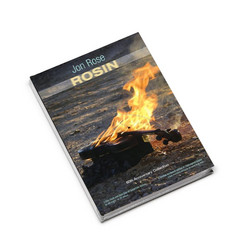
Rosenberg Museum - An Incomplete Catalogue. In Jon Rose’s own words: "The Rosenberg Museum is a critical component of the Gesamtkunstwerk centred on my instrument - the violin. When in 1976 I first imagined such a conceit, I had few resources with which to realise an ambitious project, but slowly I put flesh on the bones. The violin became generic: everything on, with, and about the instrument that my imagination could create. The museum remains a clearing house for experiments and contexts.
The itinerant life of a practising musician meant the museum never had a permanent home until I moved to the centre of Australia in 2021, finally gaining a suitable space for both museum and concerts. The museum collects not only my own homemade or hacked string instrument inventions and derivatives, but also violin stories - both true and fabricated - pertaining to the musical other, historically twisted, or culturally critical. The museum holds 65 playable instruments at last count, and something like 1,000 other artefacts of violin iconography. Over the years, some nine instruments - such as the 19-String Violin or the 19-String Cello - have disappeared or (hard to believe) been stolen. Like an exercise in entropy and improvised music itself, the museum has always been in transit and transition. As Karl Marx noted, ‘All that is solid melts into air.’
There is an empirical logic to a new instrument: it will produce only new music. There may be references to other musics played on other instruments in other cultures, in other times, by experienced hands and ears, but a new instrument, by definition, generates new sounds previously unheard. What drives the desire to construct? It certainly doesn’t help a career in either popular or unpopular music. Often impractical and time consuming, there is little to recommend it beyond the sheer satisfaction of the doing. However sophisticated the project, a moment always comes to every new musical instrument: the instant a string is attached to this previously unsounded object. That moment cannot be replicated. Later, I may find other ways of playing the instrument, or repurpose it altogether, but that initial sonic singularity is magic.
Most sonic objects I have requisitioned are manmade - fences, doors, chairs, drainpipes, a coffin, car wrecks, sports equipment, kitchen sinks, bicycles, plywood, corrugated iron. I note that DIY building materials prevail. The list also reflects the time in which I live; I cannot pick another. (Recasting the function of the 500-year-old violin was a given; it’s what I was presented with at the age of seven.) Had I lived preindustrial revolution, I might have been more interested in pumping up sheep stomachs or harnessing the power of the local windmill. And who did invent that all-purpose driver - the wheel?
But we are now postindustrial, so inevitably I have had to deal with the binary, hence the interactive MIDI violin bow. Yet in recent years, despite wide ranging and joyful digital experiments (like that bow), I have returned to the analogue physical world - the irreplaceable first principles of music.
In traditional Aboriginal perception, there is no such thing as an inanimate object; animal, vegetable, and mineral are all connected to a living continuum. That rock, river, animal, and kinship experience may exist in a mythical past or the everyday present - or simultaneously in both - is postmodern before its time. The object may lie in wait for the relevant song with which humans will recognise its quality of livingness. There is very little on this planet that does not make a sound when excited by bow, stick, wind, water, electricity - whatever.
Living in Central Australia, with its precursor of ancient Indigenous musical instrument appropriations from nature juxtaposed with its recently imposed flimsy colonial infrastructure, makes a certain sense to me. With the instrument collection now easily accessible, I can see that - apart from fundamental sonic exploration - there is something of the early 20th-century ‘one man band’ about the physical requirements and combinations of these inventions. I’m happy to be part of that tradition.
Except where indicated, all tracks were played and recorded in real time with no overdubbing or studio effects and (unless stated) were recorded in 2025/26 through a long series of repairs, re-learnings, new setups, discoveries, and renditions. There is no reverb or other postproduction effect added (except tracks 36 & 37) - this is the sound of the instruments in the museum or the local environment. All recordings were performed and mixed by me, with minimal editing. Instruments from non-Western traditions that remain influential on my work also feature in the museum: https://www.jonroseweb.com/e_vworld_violin's_relatives.php"
![Σ [sigma]](https://cdn.soundohm.com/data/products/2026-10/a0550686140_10-jpg.jpg.250.jpg)