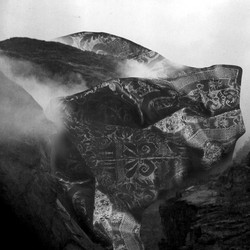
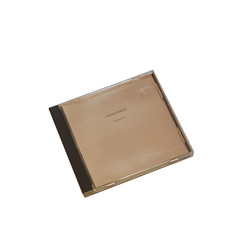
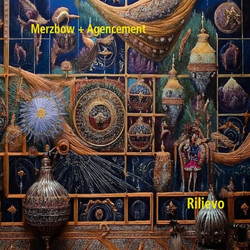
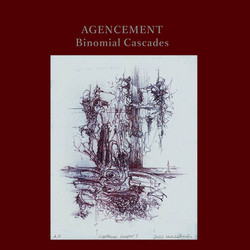
New CD from Agencement, the long running solo project of the Japanese violinist, improviser, and painter Hideaki Shimada, the first release on Pogus in five years, and it closes a circle more than three and a half decades in the making. As Al Margolis, the label's founder and a singular force within American experimental music since the early 1980s, has long made clear, Pogus had wanted to issue Shimada's work since the very beginning. That it finally appears now, with Margolis himself among the players, gives the album the weight of something both inevitable and quietly miraculous.
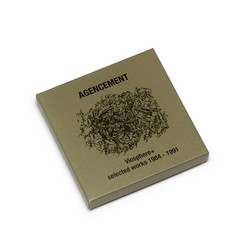
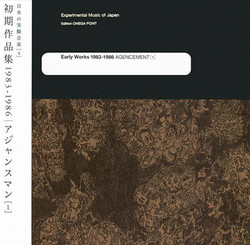
Shimada's path runs through one of the richest undercurrents of postwar Japanese sound. Born in 1962, he came of age within KUC, the Kanazawa citizens' collective whose journal Avant-garde opened a window onto the rarest reaches of progressive rock, free jazz, and contemporary composition. It was through the example of Derek Bailey that he first took up improvised violin at the turn of the 1980s, and by mid decade he had begun building the multitracked, self contained world of Agencement, a music made entirely from layered violin and assembled with the patience of a painter laying down glazes. He moved easily through the Japanese noise milieu of those years, sharing stages with figures such as Merzbow, before his third album, Viosphere, drew international acclaim in 1991 and then, characteristically, he withdrew, releasing little while the decades turned.
What unfolded afterward reads less as a career than as a slow widening of community. From the 2000s onward Shimada became a gathering point, performing in London at Mopomoso, the long running improvised music series convened by guitarist John Russell, and bringing an extraordinary roster of players to Kanazawa, among them Eddie Prévost, John Butcher, Sabu Toyozumi, Roger Turner, and Evan Parker, often at the 21st Century Museum of Contemporary Art. In 2024 he broke a thirty five year silence on vinyl with Binomial Cascades. The present recording extends that reawakening, and does so by reaching back. It opens with an echo that recalls his very first LP, a faint resonance of the late 1980s and of those early transatlantic letters exchanged with Margolis and with David Prescott of Generations Unlimited, the American label that first carried his music abroad.
Yet this is no exercise in nostalgia. Where the early Agencement was a closed architecture of violin alone, here Shimada turns toward the orchestral, folding in violas and cellos, shifting frequencies, and handing the wind and brass to Margolis, so that the long distance correspondence of 1990 becomes, at last, a shared act of making. Completed in the winter of 2025 and 2026 rather than across the customary year of recording and mixing, it carries the charge of a new beginning, and Shimada suggests this orchestral turn will continue to evolve in the years ahead. The instruction he leaves the listener is the only one such music ever needs. Listen.
```