François Couturier, Anja Lechner, Jean-Louis Matinier, Jean-Marc Larché
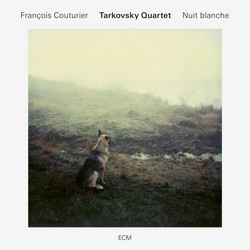
Tarkovsky Quartet
Tarkovsky Quartet closes the trilogy of albums that the French pianist François Couturier built around the films and writings of Andrei Tarkovsky. The group from Nostalghia - Song for Tarkovsky (2006) now takes the director's name, and its frame of reference widens. Nine compositions by Couturier carry echoes of Pergolesi, Bach and Shostakovich, and three pieces are improvised by the whole quartet.
The line-up pairs musicians from different worlds: Couturier on piano, the German cellist Anja Lechner, accordionist Jean-Louis Matinier and Jean-Marc Larché on soprano saxophone. As the Neue Zürcher Zeitung put it, a classical cellist, an improvising accordionist and a jazz saxophonist take the music far from ready-made stylistic paths. Couturier, Larché and Matinier had already recorded together as a trio before ECM, and between the two quartet albums came Couturier's solo piano record Un jour si blanc. This one was made in December 2009 at the Auditorio Radiotelevisione Svizzera in Lugano, in collaboration with RSI Rete Due. Markus Heiland was the engineer and Manfred Eicher produced.
Every title points to Tarkovsky's life or work. Some are family nicknames for his son and mother (Tiapa, Maroussia), others name the Dostoevsky prince of Mychkine or his favourite Bresson film, Mouchette. A celui qui a vu l'ange, the opening piece, takes its name from the epitaph on his grave and its inspiration from the Quis est homo of Pergolesi's Stabat Mater. Doktor Faustus refers to the Thomas Mann novel Tarkovsky hoped to film and alludes to Shostakovich's Cello Sonata, Op. 40. The improvised San Galgano is named after the ruined abbey in Nostalghia, the film of 1983.
John Kelman wrote in All About Jazz that the quartet showed "even greater synchronicity amongst the four musicians than on Nostalghia". He pointed to arrangements that move between solo, duo, trio and quartet, often within a single piece, and to the blend of saxophone and accordion, two reed instruments. In Le Monde, Francis Marmande called it an extraordinary album for its colour and its intensity, and for the way it drifts around the titles and mental images of the filmmaker.
This is the CD edition, ECM 2159, first released on 18 March 2011.