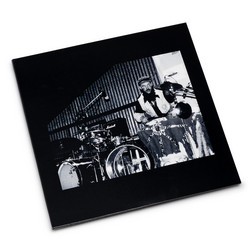
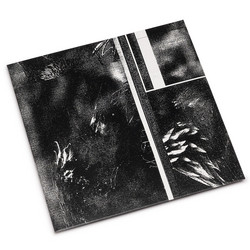
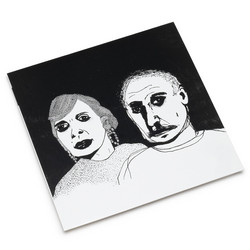
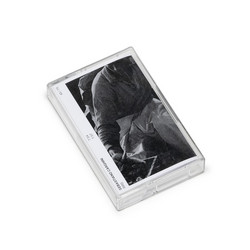
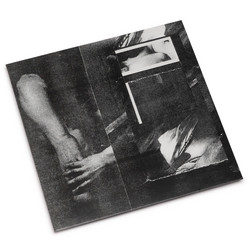
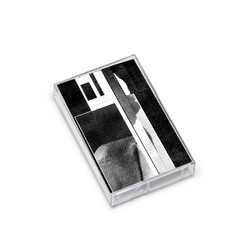
With The Fullness of a House, Nial Morgan steps into focus not through scale or volume, but through a radical narrowing of means. Long embedded in Los Angeles’s experimental music scene, he has typically operated at the edges of abrasiveness and immediacy, favoring sharp-edged electronics and high-impact gestures. Here, the register shifts inward. The CD debut for Second Sleep is built almost entirely from the exhausted breath of cheap variable-speed fans and the resonant character of a handful of domestic objects - a big wooden box, duralex glasses, a stainless-steel baster, and other household cast members - arranged with almost monastic restraint. No elaborate processing chains, no digital sleights of hand; just basic linear arrangement and a steadfast refusal to adorn.
The result is a body of work that treats the home not as a refuge from sound, but as an instrument already in motion. Across seven concise pieces assembled between 2022 and 2024, air currents, motor fatigue and sympathetic resonances turn the recording space into a kind of low-voltage ecosystem. Tones do not arrive from nowhere; they seem to seep out of walls, table surfaces, cabinet interiors, arriving half-formed and slightly off-center, as if caught mid-thought. The instability of the electrical systems - the fans straining, stuttering, drifting out of their nominal speeds - becomes the generative core of the music. Each wobble in pitch, each irregular tremor, each sudden dip in intensity is folded into the composition rather than smoothed away.
Morgan’s approach balances rigorous electroacoustic thinking with a willingness to let things fall apart. On one level, the record belongs to a lineage that runs from musique concrète through minimal drone and contemporary electroacoustic composition: close-miked sources, an emphasis on timbre and duration, structures that reveal themselves gradually rather than through overt themes. Yet The Fullness of a House avoids academic distance. There is a palpable emotional and physical presence in the way sounds are allowed to fray, clip, or collapse into silence. Technical fragility becomes expressive, the audible effort of cheap fans and resonant objects mirroring the “tired forms” and “resulting impasse” Morgan invokes in his own note on the work.
That note frames the album as “a collection of short recordings realized through the fatigue of cheap variable speed controlled fans and the resonant character of [big wooden box, duralex glasses, stainless steel baster etc.] with no additional processing apart from some basic linear arrangement,” and goes on to mention “thinking about tired forms, the resulting impasse, and my own positioning; largely inconclusive. Assembled from 2022-2024.” The inconclusiveness is crucial. These pieces never resolve into neat arcs or narrative closure. Instead, they trace the contours of a thought that keeps doubling back on itself, examining the same domestic materials from slightly different angles, allowing microscopic details, accidental harmonics and fleeting dynamic openings to surface as if by chance.
Listening, you become attuned to the in-between zones the record inhabits. It is neither field recording nor pure abstraction, neither nostalgic homage to concrete music nor a cold exercise in technique. Instead, The Fullness of a House occupies a liminal space where interference patterns begin to feel like memory, and the drone of a fan can suddenly tilt into something resembling melody before slipping away again. Noise is not treated as disturbance to be minimized, but as narrative material in its own right, a way of charting the house’s daily fatigue and, by extension, the artist’s own.