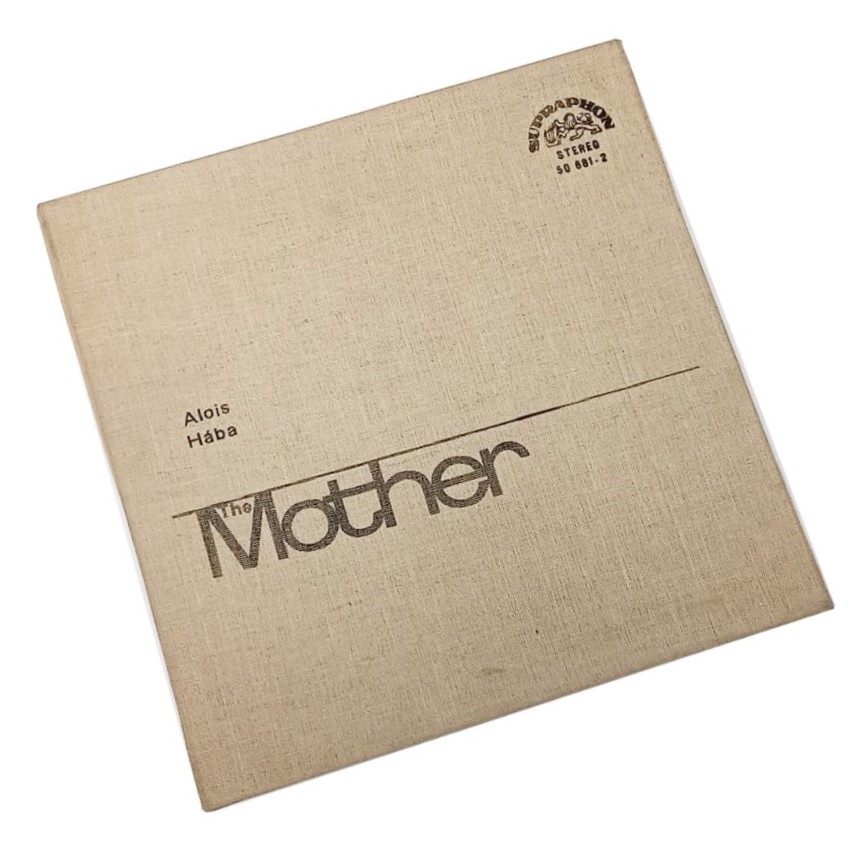
Alois Hába
The Mother (2LP box)
Format2LP BoxLabelSupraphonGenreComposition
Out of stock
Tracked express shipping from Italy, no customs or import VAT in the EU. Shipping costs
condition (records/box): NM / EX Insert included.
The problem Alois Hába (1893-1973) set himself in the 1920s was not merely technical. It was philosophical. Conventional chromatic harmony, he argued, had exhausted its expressive resources - not because composers had failed to use it well, but because it was structurally incapable of conveying certain registers of experience. The answer, he proposed, was to divide the octave further. Quarter-tones - intervals half the size of a semitone - offered a system whose harmonic logic he codified in his monumental New Harmony-Textbook (1927), and which he argued was prefigured in the microtonal inflections of his native Moravian folk music. He had special quarter-tone pianos, clarinets, and trumpets constructed. He founded a department of quarter-tone music at the Prague Conservatory. And in 1927-28 he composed Matka (The Mother), a full-scale opera in ten scenes - the first, and still among the very few, operas written entirely in the quarter-tone system.
The libretto is Hába's own, drawn from the peasant world of his native Valašsko in the eastern Czech highlands. The plot is deliberately plain: a mother, her family, the arc of ordinary life. The austerity is deliberate. Hába's aesthetic concept of "athematicism" - the avoidance of repetition and variation of memorable themes, replaced by a continuous, non-repeating melodic flow - meant that the quarter-tone inflections of the singers and instruments could not rely on recognizable material to carry the emotional weight. Everything had to work in the moment, through texture and intonation alone. The Prague premiere in 1931 established Hába internationally as the most consequential microtonal composer of his generation. The Nazis banned his work in 1939. The communists labeled him a formalist and sent him into retirement in 1953. He described his retirement as the beginning of real creative freedom.
Recorded in 1964 at Prague's Domovina Studio with the Prague National Theatre Chorus and Orchestra under conductor Jiří Jirouš; quarter-tone piano by Jiří Pokorný. Issued by Supraphon in a two-LP box with full libretto and notes in Czech, English, French, and German. One of the essential documents in the history of 20th-century opera.
Release notes
Quarter-Tone Opera in 10 Scenes Prague National Theatre ℗ 1965 2LP box set with linen cover Includes 10 page booklet with multilingual notes by the composer; no libretto.
| 1-1 | Scenes I and II (1) | ||
| 2-1 | Scenes II (2) - V (1) | ||
| 3-1 | Scenes V (2) - VII | ||
| 4-1 | Scenes VII - X |
- Prague National Theatre Chorus
- Chorus
- Alois Hába
- Composed By, Libretto By, Liner Notes
- Jiří Jirouš
- Conductor
- Josef Kalousek
- Cover
- Miloslav Kulhan
- Engineer [Sound and cut]
- Prague National Theatre Orchestra
- Orchestra
- Dr. Eduard Herzog
- Supervised By [Musical supervision]
- Milan Karpíšek
- Vocals [Bridegroom's Man]
- Hana Zelenková
- Vocals [Bridesmaid], Vocals [Second Lachrymose Old Woman]
- Přemysl Kočí
- Vocals [Brother-In-Law]
- Jana Kostelecká
- Vocals [First Lachrymose Old Woman]
- Oldřich Spisar
- Vocals [Francek Křen]
- Lubomír Havlák
- Vocals [Francek]
- Marcela Lemariová
- Vocals [Francka]
- Vladimír Jedenáctík
- Vocals [Her Father]
- Jana Polívková
- Vocals [Maruša, jun], Vocals [Third Lachrymose Old Woman]
- Vlasta Urbanová
- Vocals [Maruša]
- Marta Sandtnerová
- Vocals [Nanka]
- Jaromír Bělor
- Vocals [Neighbour]
- Jiří Janoušek
- Vocals [Priest]
- Eva Zikmundová
- Vocals [Sister-In-Law]
- Miroslav Borský
- Vocals [Vincek]


