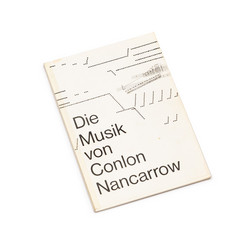
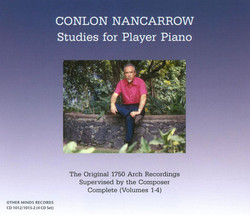
As Fast as Possible looks at Conlon Nancarrow beyond the player piano. Nancarrow, born in Texarkana, Arkansas, on 27 October 1912 and died in Mexico City on 10 August 1997, was a Mexican composer of American origin. He entered history above all through his Studies for Player Piano. This disc sets five of those studies, in versions for live pianists, beside his works for orchestra and ensemble, and ends with a concerto by Paul Usher written in Nancarrow's spirit.
The performers are the pianists Amy Briggs, Helena Bugallo, Ingrid Karlen and Amy Williams, the pianolist Rex Lawson, Ensemble Modern under Kasper de Roo, and the WDR Sinfonieorchester Köln under Stefan Asbury. The recordings are a 2004-2005 production of Westdeutscher Rundfunk, in coproduction with Ensemble Modern, with Harry Vogt as executive producer and Stephan Hahn and Stephan Schmidt as recording producers.
The four-movement Suite for Orchestra (1940), played by the WDR orchestra, and the Septet (1939), a fragment rediscovered only in 1990, belong to Nancarrow's early period of live instrumental music, roughly 1930-1947. IRCAM counts fewer than twelve short works for standard instruments from 1930 to 1945, most using several simultaneous tempi; Henry Cowell's book New Musical Resources, which recommended the player piano for such rhythms, then turned him toward the machine. The Three Movements for Chamber Orchestra (1993) come from his later years, when he again wrote for live players alongside new player-piano pieces; a handwritten note in some of these scores shows they were transcriptions made with the help of his assistant. The studies are heard in transcriptions for two to four pianos: No. 16 for two pianos eight hands by Erik Ona, Nos. 20 and 32 for piano four hands by Helena Bugallo, No. 26 for four pianos seven hands, and No. 44, the Aleatory Canon (Round), which at over eleven minutes is the longest of them.
Transcription marks Nancarrow's late period, devoted to arrangements of his own and others' works for concert use. Usher's Nancarrow Concerto for Pianola and Chamber Orchestra, in four movements and almost twenty minutes long, shows how far such a transcription can move from its source, and brings the mechanical piano back as a solo instrument, played by Lawson with Ensemble Modern.
CD, Wergo WER 6733 2, released in 2011.