Invisible Cities by the American composer Michael McNabb was created at the Center for Computer Research in Music and Acoustics (CCRMA) at Stanford University. It began in 1985 as music for a dance theatre production, inspired by Italo Calvino's novel Le città invisibili. Computer and synthesizer sounds meet piano and soprano saxophone in six imaginary cityscapes.
McNabb studied composition at Stanford with John Chowning and Leland Smith, and he was one of the composers who helped develop digital synthesis and processing at CCRMA in its early years. Here he plays soprano saxophone and handles the synthesis and processing himself. The pianist is Artis Wodehouse. McNabb also wrote the liner notes. McNabb holds a Doctor of Musical Arts in composition from Stanford, was later manager of sound and music software at NeXT Computer, and received two fellowships from the National Endowment for the Arts, in 1980 and 1985.
The six pieces are named after imaginary cities. They are City of No Resistance, City of Wind, City of Congruence, City of Desire, Hidden City and City of Reflection. Most run about eight minutes, with the short Hidden City at the centre of the second half. The label describes very different imaginary soundscapes, in which McNabb walks a razor-sharp line between the structures of serious music and a pop-oriented sound aesthetic.
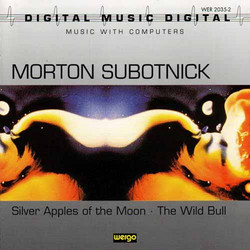
CCRMA, where McNabb worked, was one of the American centres of digital synthesis in those years, and the label calls it renowned. The six pieces were first heard with dancers in 1985, and the CD presents the music on its own. The disc belongs to Digital Music Digital, the CD series that Johannes Goebel initiated with Wergo in 1986, among the first to use the new medium for digital music. McNabb's earlier CCRMA works, among them Dreamsong, appeared in the same series, and he also assisted with the digital engineering of the CCRMA anthology Dinosaur Music. The production was ODC/Dance's Invisible Cities, choreographed and directed by Brenda Way and conceived by McNabb with the roboticist Gayle Curtis. It was the first full-length ballet to feature a choreographed robotic dancer: a Unimation Puma 560 played Kublai Khan, with KT Nelson as Marco Polo. It opened at Stanford's Memorial Auditorium on 6 and 7 December 1985.
CD, Wergo WER 2015-50, first issued in 1989; Discogs lists this barcoded edition as a reissue. Total time 42 minutes 43 seconds.