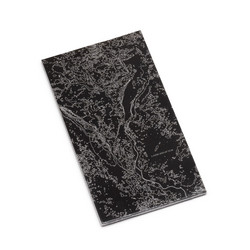
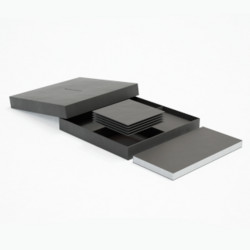
*200 copies limited edition* Kozmické louky begins with a place. The title names a wetland in Czech Silesia, pressed up against the Polish border, and one of the last two remaining floodplain areas along the Opava River, locally known as the Opavice. Once degraded, these alluvial meadows have in recent years been brought back to life through careful restoration; they are again home to dense, interlocking communities of birds, insects, plants and amphibians, even as they sit squarely inside the overlapping pressures of local and global climate crisis. For Magdaléna Manderlová, who comes from this region, Kozmické louky is not just a landscape but a sounding body - a place that breathes with the river, remembers water, and registers change in every rustle, call and shift of weather. The album that bears its name listens closely to these meadows over time, entering into a dialogue with them through field recordings and electroacoustic compositions made on site or in close relation to it between 2021 and 2025.
The record’s first seven pieces are recorded, composed and mixed by Manderlová herself, establishing a vocabulary in which microphones, synthesis and text operate as ways of thinking with the wetland rather than merely documenting it. Her practice, already evident in earlier works like Straw Bales, treats field recording as a porous medium: frog choruses, wind across sedges, distant road noise and mechanical hums are not neutral “backgrounds” but actors in a shared scene. These sounds are often left recognisable, but they are also stretched, layered, filtered or folded back on themselves, creating a blurred zone where direct environmental capture shades into dream, memory and speculation. Across these tracks, time is elastic. You can feel the seasonal cycles of Kozmické louky - thaw, flood, bloom, drought - compressed and refracted, as if the meadow were replaying years of its own listening in a compressed span.
From track eight onward, Kozmické louky opens out into a genuinely polyphonic project. Long‑time environmental sound artist Peter Cusack contributes a composed, performed, recorded and mixed piece of his own, bringing his deep experience of “sonic journalism” to bear on the floodplain. Lucie Páchová follows with a work composed, performed, recorded and mixed by her, using field recordings provided by Cusack as both anchor and point of departure. A 2023 live score by Manderlová, performed by symposium participants on site at Kozmické louky, pulls the wider community directly into the record: a document of collective, in‑situ listening and sounding where the meadow and its human visitors briefly form a single ensemble. Michal Kindernay - Manderlová’s collaborator on the broader Kozmic sounds initiative - contributes a piece he recorded, composed and mixed himself, extending the album’s viewpoint and technical approach.
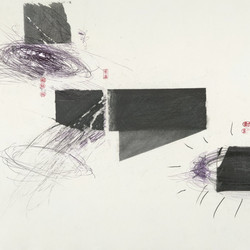
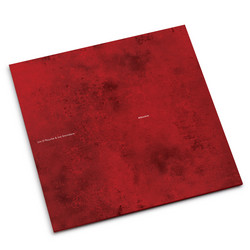
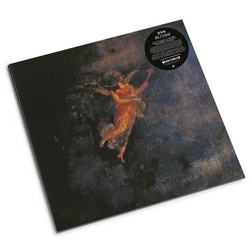
The final stretch of the record deepens the sense of relational listening. One piece is recorded and composed by Manderlová featuring Věra Manderlová, mixed by Kristoffer Lislegaard; another is co‑composed by Adela Mede, Klaus Ellerhusen Holm and Manderlová, again mixed by Lislegaard. These collaborations thicken the web of perspectives, letting different musical languages and personal histories resonate through the same wetland focus. Throughout, mastering by Lasse Marhaug ensures that the album’s quietest details and densest accumulations remain vivid, preserving both the subtlety of faint environmental sounds and the full grain of amplified, processed material. The cover art and graphic design by Kateřina Havelková give visual form to this world, while liner notes by Manderlová and Kindernay, plus a poem by František Hruška, draw out the literary and reflective dimensions of the project.
Released by Gruenrekorder as part of its Field Recording Series, Kozmické louky arrives within a catalogue that has long explored the creative edges of environmental sound work. Yet it also stands as the aural counterpart to a larger, site‑specific investigation. The album was created alongside the long‑term project Kozmic sounds, developed by Manderlová and Kindernay and initiated and commissioned by Bludný kámen in 2021. That project, which has included installations, radio works and on‑site events, listens to the evolving soundscapes of the Opava and its living floodplains, attending to the wetland as both ecological system and cultural space. Support from the Arts Council Norway, Atelier Nord, Bludný kámen, the Composers Remuneration Fund and Notam reflects the project’s transnational character: an artist from Silesia now based in Norway returns to a home landscape to hear it anew, bringing with her a network of institutions and collaborators who help amplify its fragile, local story into a wider field of attention.