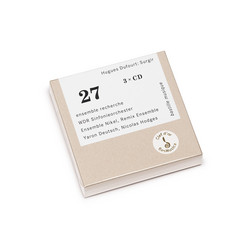
Twenty-nine new love songs written for ensemble recherche, plus a Mozart arrangement, on two discs. While preparing their 25th anniversary in 2010, the musicians decided that "there are no love songs anymore", and asked composer friends to write some. More than thirty arrived, and this set gathers most of them into a single cycle of short pieces. The set was placed on the quarterly list of the German Record Critics' Award in 3/2014.
The ensemble was founded in Freiburg im Breisgau in 1985. The players here are Melise Mellinger (violin), Barbara Maurer (viola), Åsa Åkerberg (cello), Martin Fahlenbock (flutes) and others, including pianists Klaus Steffes-Holländer and Jean-Pierre Collot and percussionist Christian Dierstein. The composers range across generations and countries, from Hans Zender and Nicolaus A. Huber to Chaya Czernowin, Georg Friedrich Haas, Enno Poppe, Jörg Widmann and Hans Abrahamsen. The recording is a production of WDR.
The love on offer covers the whole span from agape, selfless devotion, to eros, and sometimes it is simply the composer's friendship for the ensemble. Forms vary just as much. Huber's An die Musik. Poem - Liebesradierung adds Swiss army knives, tables and transparent paper to the eight players. Haas contributes three tiny Liebeslieder from Aus.Weg that together last little more than a minute. Johannes Schöllhorn's Chanson. Ein Liebeslied mit Ernst Jandl is over in 41 seconds, while Günter Steinke's für dich runs almost thirteen minutes. Zender writes an Alfabet (Kamasutra) for flute and four instruments, and Fabio Nieder a "love song in three pictures" with synthesizer or accordion. One piece looks back two centuries: Salvatore Sciarrino arranged Mozart's Adagio for glass harmonica KV 356 for six players.
Many of the titles turn the old word over: Liebeslied from Abrahamsen, Carola Bauckholt and Widmann, Lovesong from Czernowin, Lied ohne Worte from Ramon Lazkano, Chant d'amour from Johannes Maria Staud. Others hide it, as in Poppe's Schweiß (Sweat) or Martin Smolka's AMarcORdOSO. Gramophone reviewed the set in its September 2014 issue. Heard together, the pieces give a cross-section of what composers active around 2010 made of a genre the ensemble thought had disappeared.
2CD, Wergo WER 6792 2, released in 2014 (total time 145'35").