Toshiro MayuzumiFeaturing: Aki Takahashi
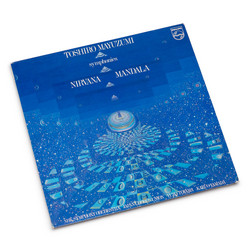
Nirvãna-Symphonie (LP)
condition (record/box): VG+ (some surface noise) / VG+ (2" upper seam split and minimal wear on back)
Insert included.
This is the one. Toshiro Mayuzumi's Nirvāna-Symphonie (1958) occupies a position in the history of twentieth-century orchestral music that has only gradually been acknowledged in the West - a position comparable in its singularity and ambition to the major works of Xenakis or Messiaen, and achieved by a path entirely its own. Born in Yokohama in 1929, Mayuzumi studied at the Tokyo National University of Fine Arts and Music, then travelled to Paris on a French government scholarship, where he encountered musique concrète and the post-war European avant-garde. He absorbed both and returned to Japan carrying neither as doctrine. His distinctive early move - Japan's first musique concrète work, X·Y·Z (1953), created with NHK Radio - was followed, from 1957, by a decisive turn toward pan-Asian sonority as the primary material of his composing.
The Nirvāna-Symphonie is the result: a large-scale orchestral work built on the acoustic properties and ritual resonance of Buddhist temple bells (bonshō), incorporating shōmyō chant for male chorus and orchestra, organized in seven movements named after stages of a bell's sound - its attack, its sustain, its decay. The bell is not used as coloristic addition but as the structural model: the entire first movement is an orchestral exploration of what a bronze bell does to the air. The choral writing that follows is not transcription of actual chanting but composition deeply informed by its acoustic behavior - the way pitch, in Buddhist vocal practice, is carried by the breath rather than fixed. Varèse is audible in the harmonic language; but the deeper logic is Mayuzumi's alone, and it had, by the time John Huston heard a recording and commissioned him to score The Bible: In the Beginning... (1966), already begun to travel far beyond the Tokyo concert hall where it premiered.