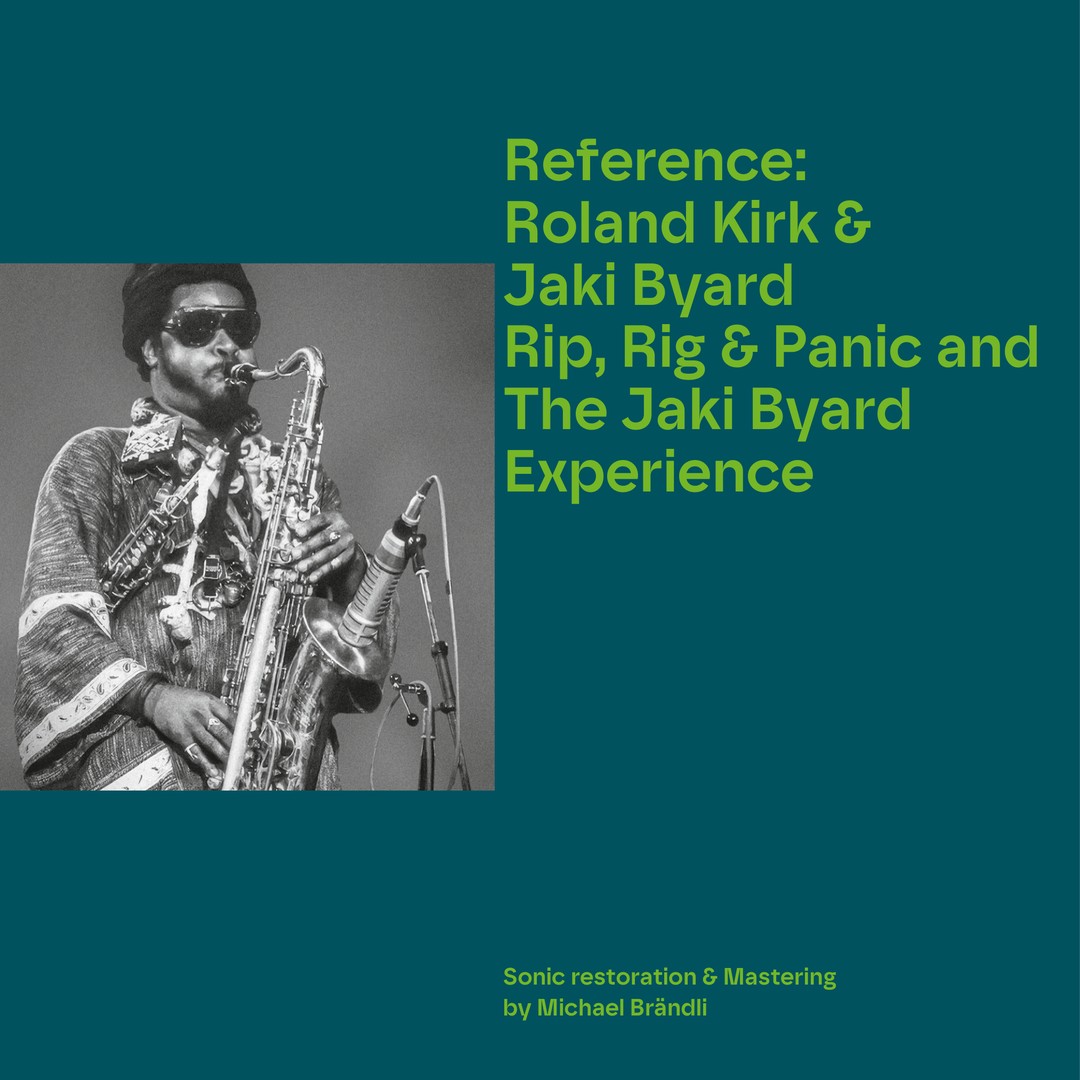
Rahsaan Roland Kirk, Jaki Byard
Reference: Roland Kirk & Jaki Byard Rip, Rig & Panic and The Jaki Byard Experience
FormatCDLabelAlAyGenreJazz & Improvisation
Preorder: Releases November 20th 2026 (ships as soon as it is released)
Tracked express shipping from Italy, no customs or import VAT in the EU. Shipping costs
The word is surreal. That is, according to various dictionaries, “having the disorienting, hallucinatory quality of a dream” and “characterized by fantastic imagery and incongruous juxtapositions.” The dream connection is especially apt, as Rahsaan Roland Kirk often acknowledged the breadth of creative resources that came to him through dreams. And the style-morphing, often jolting juxtapositions of musical shape and sensibility that occur from moment to moment, without warning, disrupt the flow of events and offer alternative dimensions to our experience and understanding of the past, present, and future of, as Rahsaan put it, Black Classical Music. Sharing - apart from brilliant instrumental virtuosity - a deep knowledge of and, further, devotion to (one might almost say obsession with) the full, rich history of jazz, classical, and experimental music, and a creative urgency that saw no boundaries to self-expression, Rahsaan Roland Kirk and Jaki Byard were kindred spirits, a perfect partnership. Though according to Byard their paths first crossed in the 1950s, and both received valuable exposure performing (albeit not together) with Charles Mingus in the early 1960s, these two albums, from 1965 and 1968 respectively, are (outside of a few tracks from Kirk’s subsequent Here Comes the Whistleman) their only recorded collaboration, a pair of matching jewels unified by specific conceptual attitudes and the audible intensity behind every note.
Though thirteen years younger than Byard, by 1965 Kirk had led more recording sessions which featured a legion of impressive pianists, including Herbie Hancock, Andrew Hill, Hank Jones, Harold Mabern, Horace Parlan, and Tete Montoliu. None, however, could apply the range of cultural and period styles, from Chopinesque romance to two-fisted stride and atonal arabesques, that Byard unselfconsciously wove into a typical solo. This fluidity of timewarped phrasing dovetailed symbolically and literally with Kirk’s penchant for referencing his musical heroes through characteristic details and compositional dedications. Thus, on Rip, Rig, and Panic, there is the triple pun of “No Tonic Pres” (built upon an allusion to Lester Young, a melody without an obvious home key or “tonic,” and, quite possibly, an alcoholic beverage a la Monk’s “Straight, No Chaser”), plus the self-explanatory “From Bechet, Byas, and Fats” - note, crucially, that the title does not dedicate the music to them, but acknowledges that Kirk has received inspiration from them - where Byard echoes Fats Waller’s stride and then orchestrates the piano, while Kirk insinuates Sidney Bechet’s unique tonal qualities with his manzello and Don Byas’ robust demeanor with an avalanche of tenor sax. (The ingenious use of chimes here adds a suggestion of church bells in their honor.) Equally, Kirk originals “Mystical Dreams” (with its haunted multi-horn intro and ending), “Rip, Rig, and Panic” (Kirk’s tenor sax scorching the air, and Byard’s modernistic vamping), and “Slippery, Hippery, Flippery” pursue further reaches of hyper-reality, the latter two including taped musique concrete and quasi-electronic episodes in homage to another adventurous sound manipulator, Edgard Varèse (one wonders if Rahsaan’s predilection for the siren comes from Varèse’s 1929-31 Ionisation, or is a representation of the ever-present dangers of the urban landscape). Remarkably, The Jaki Byard Experience picks up, three years later, precisely where Kirk’s album left off (though Alan Dawson, Byard’s frequent rhythm section companion, replaces the volatile Elvin Jones, Richard Davis remains to stimulate the foundation). This time, Byard chooses three pianists of significantly diverse characteristics for recognition, Bud Powell (the boisterous harmonic concurrences of “Parisian Thoroughfare”), Thelonious Monk (an inside-out reconsideration of “Evidence” based on elaboration - a torrential Kirk solo - rather than Monk’s reductive abstraction), and Eubie Blake (“Memories of You,” with Byard channeling Art Tatum for good measure, and Kirk circular breathing through the entire out-chorus, in case you hadn’t noticed). Likewise, these transformative, subversively tongue-in-cheek, instincts invigorate the sanctified “Shine on Me” and “Teach Me Tonight” (opening with school bells and Byard quoting “School Days” until Davis takes possession on the way home). By way of contrast, Byard’s composition “Hazy Eve” has a spontaneity and melodic generosity worthy of Brahms, or Billy Strayhorn.
For some artists - consider Rene Magritte’s almost believable distortions of everyday reality, or the dreamlike playful wit of Joan Miró - a surreal vision is merely a heightened degree of ordinary perception, a response to, and not a rejection of, the myriad possibilities of life. To quote Rahsaan Roland Kirk, “This album is my way of expressing freedom.” Art Lange, Chicago, April 2025


