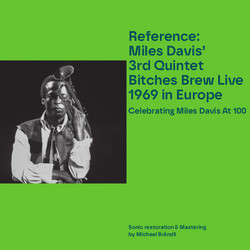
“Critically and popularly acknowledged as one of the most creative and influential ensembles in the evolutionary history of jazz, the Miles Davis quintet of roughly Fall 1964 (Wayne Shorter being the final addition, the rhythm section having been working with Miles for nearly a year-and-a-half prior to this) until its demise in late 1968 was actually, over the course of these four years, the equivalent of several bands exploring, experimenting with, and redefining their musical attitudes and stylistic identity - both with and without Miles. When Herbie Hancock, Ron Carter, and Tony Williams “officially” left the group to pursue their own full-time projects (Williams nevertheless participated in the recordings that resulted in 1969’s In a Silent Way, while Hancock continued to contribute to sporadic studio sessions well into 1970) Miles was obliged to assemble the new rhythm section that became known as the Third, or “Lost” Quintet (heard on Reference: Bitches Brew Live 1969 In Europe, thingamajig 2-2510) - and yet, in truth, he had presaged the Second Quintet’s obsolescence as early as December ’67 and January ‘68, indicating his desire for a new studio sound when he began augmenting the group with guitarists (Joe Beck, Bucky Pizzarelli, George Benson) and surprised Hancock with an electric piano, on tracks that would appear on Miles In The Sky and various miscellaneous compilations. Thus these live recordings from their European and Scandinavian tour of October and November 1967 should be considered the final chapter in the metamorphosis of this form-stretching ensemble.
From the beginning, the musical changes instigated by the new quintet members were radical and significant. Between the gradual dissolution of the First “classic” quintet (marked, most dramatically, by the departures of Philly Joe Jones in 1958 and John Coltrane in Spring 1960, respectively) and the adoption of the so-called Second Quintet’s rhythm section in the Spring of 1963, Miles was treading water, accompanied by supportive but non-challenging sidemen and relying on a comfortable, consistently recycled repertoire of standard material. But though the initial evidence of an internal transformation appears on the live recordings from New York’s Philharmonic Hall in February 1964, where the group dynamics and sensitive interaction have started to affect their spontaneous reshaping of the familiar songs, an even stronger indication of things to come may be heard on the Japanese concerts (via authorized and bootleg releases) from just five months later, after Sam Rivers (whose more adventurous style anticipated the ingenuity of Wayne Shorter in this context) had replaced the reliable but out-of-his-element George Coleman. In Japan, the 18-year-old Tony Williams is given free rein to upset rhythmic continuity, and, amid suspended chords and thematic extensions, with less harmonic responsibility Hancock varies the colors and density of his nuanced comping behind the soloists. Miles responds with greater abstraction in a style he would continue to develop over the years, splattering and splaying notes in uneven phrases, squeezing and distorting pitch in the cracks of melody.
Rivers’ appointment, alas, was short-lived, but the addition of Shorter was to have deeper, more lasting consequences, most notably in the ongoing disparity between the group’s studio albums and live performances. From January 1965 to June ’67 the band recorded E.S.P., Miles Smiles, Sorcerer, and Nefertiti - containing an influx of new, original material of a decidedly modern perspective (all five contributed pieces, with Shorter the most prolific and visionary). Each album has its own ambience and spirit, but as a body of work they share consistent values - a focus on structurally concise forms that explore a primary strategy; solos that reinforce, rather than exaggerate, the character of the composition; complementary moods of impressionistic, suspenseful, melancholic, or eccentric modes of tension and release. It seems unusual that, despite the quality and distinctiveness of these individual compositions, so few were included in live performances until late 1967. For example, only one tune from E.S.P., Davis’ “Agitation,” was part of the band’s set list at the Plugged Nickel in Chicago during December 1965, which otherwise consisted of the same standards Miles had been playing in some cases since the 1950s.
The Plugged Nickel performances are crucial to understanding the development of the band as an “ensemble” - emphasizing the effect of the group’s interactive, spontaneous alterations of the formal relationships of the music. Despite (or perhaps because of) the familiarity of these songs, their labyrinthine transformations, largely twice as long as earlier live performances of the same material, make a unique impression. In the eleven-month hiatus between the recording of E.S.P. and the Plugged Nickel gig (due to Miles’ hip surgery and rehabilitation) the band members worked and recorded, separately and together, with many of the most progressive members of the jazz “avant-garde,” bringing back to Miles the discoveries they had made in the interim. Many commentators have subsequently suggested a similarity to Ornette Coleman’s post-1958 “free form” liberation, but the Davis quintet’s ’65 performances are not literally “free form,” but closer to “organic form” - as described in the 19th century by English poet and critic Samuel Taylor Coleridge: “Organic form…is innate; it shapes as it develops itself from within, and the fullness of its development is one and the same with the perfection of its outward form.” Thus, basing their rhythmic variability and harmonic suspensions on an adapted song form, their formal innovations remain to some identifiable degree “innate,” that is, imagined or devised from the essential qualities of its source, and are certainly more response-oriented - related to the collective details as they occur - than typical “free form” interaction.
With no authorized recordings of the band’s 1966 touring, there is little to illustrate the changes in format and concept that occurred between the ’65 Plugged Nickel gig and this Fall ’67 tour. Immediately noticeable is that each concert presents the same abbreviated song list (but now incorporating updated modal material from their recent albums) following, for the most part, the same order, linked together and cued by the trumpet, in concise versions with less extravagant elaboration, but raising the intensity level several degrees - Williams‘ hyperactive drumming accelerates tempos, and Shorter’s fluctuating, circuitous liberties test the tunes’ tonal limits. Hancock, then, serves to soften the rough edges, and Ron Carter’s foundation prevents the others from spinning apart under the combined centrifugal force. As an ensemble, they have achieved a near-telepathic dynamic, an intuitive sense of shared purpose - as they are about to go their separate ways. Meanwhile, Miles is Miles, riffing on the modes, quick on his feet, elusive, unpredictable, and dangerous as a panther, already looking forward to the next challenge.” - Art Lange
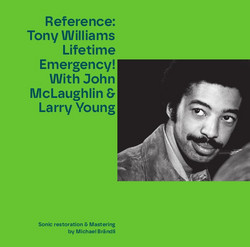
Recorded live on the Second Quintet’s autumn 1967 tour in Antwerp (October 28), Copenhagen (November 2), Paris (November 6) and Karlsruhe (November 7). Three CDs, with sound restoration and mastering by Michael Brändli, cover photo by Philippe Gras and liner notes by Art Lange, produced by Werner X. Uehlinger.