Edward Artemiev
Solaris (LP Box + Book + CD)
Label: Song Cycle
Format: LP + CD + Book
Genre: Library/Soundtracks
In process of stocking: On backorder: usually ships within a few days.
When Andrey Tarkovsky's Solaris premiered at Cannes in 1972, winning the Grand Prix Spécial du Jury, it announced a new cinematic language where sound was as essential as image. The collaboration between Tarkovsky and composer Edward Artemiev created what film critic Phillip Lopate would later call a work that belongs to that handful of filmmakers who created a universe. Roger Ebert described it as a thoughtful, deep, sensitive movie that uses the freedom of science fiction to examine human nature.
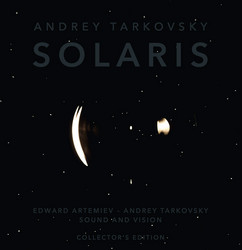
Song Cycle Records, in collaboration with the Andrey Tarkovsky International Institute, presents Solaris: Sound And Vision - The Film Album, a deluxe collector's edition limited to 1000 copies worldwide. This 30x30cm hardcover book includes the complete soundtrack on CD, 96 pages featuring 73 previously unreleased photographs from the film set, and essential essays by Naum Abramov and musicologist Roberto Calabretto.
The story begins with a paradox. Tarkovsky initially didn't want music in Solaris. When he first visited Evgeny Murzin's laboratory (home to the legendary Experimental Studio of Electronic Music in Moscow), he looked around and left. Two months later, he invited Artemiev to score the film, but with radical instructions: he needed a sound organizer, not a composer, someone to orchestrate the sounds of nature according to the laws of music.
Artemiev's solution was twofold: he appealed to Tarkovsky's love of Bach, recording variations of the Chorale Prelude in F-Minor on solo organ to represent Earth. For the enigmatic planet Solaris, he turned to the ANS synthesizer, a photoelectronic instrument invented by Murzin between 1937 and 1957, named after Alexander Nikolayevich Scriabin. Sound was synthesized from waveforms etched onto glass discs, producing 720 discrete microtones.
Only two ANS synthesizers have ever existed. The original was destroyed; the improved version now resides in the Glinka Museum in Moscow. This makes Solaris perhaps the photo-electronic instrument's pinnacle achievement. The ANS was also used by Stanislav Kreichi, Alfred Schnittke, Edison Denisov, and Sofia Gubaidulina, but Artemiev's collaboration with Tarkovsky represents its most enduring cultural impact.
For Solaris, Artemiev created what critics have described as mysterious, dreamlike and abstract; a score that operates as its own bizarre entity. He slowly developed a special musical language where clusters of soft sounds emerge, almost inaudible, sometimes overlapping. As one reviewer noted, the music's chilly, withdrawn atmosphere is so crucial that it's difficult to envision the film without it.
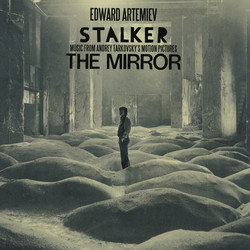
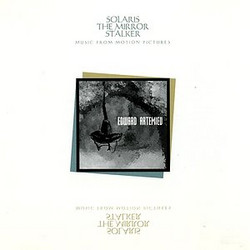
The result anticipates what Brian Eno would later formalize as ambient music. Artemiev's compositions center on Bach's somber chorale alongside dissonant crescendos and formless tracks generated by the ANS, capturing the film's meditation on time, memory, and human longing. The collaboration extended to two more Tarkovsky masterpieces: The Mirror and Stalker.
This deluxe edition offers a compelling publication for everyone who wants to dive deep into Tarkovsky's realm: a document of one of cinema's most profound artistic partnerships, and a testament to the ANS synthesizer's unique place in the history of electronic music.