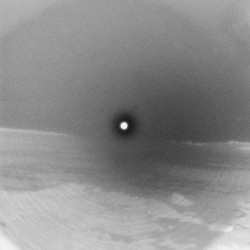
Eric La Casa, Seijiro Murayama
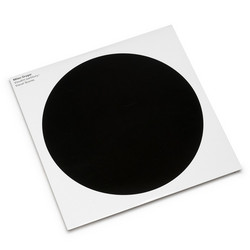
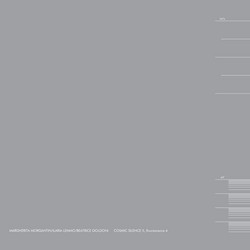
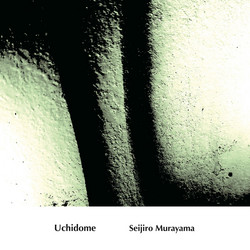
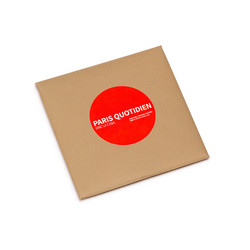
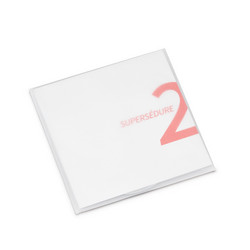
Supersédure 2 (CD + Booklet)
*100 copies limited second edition* Recorded between June 2019 and October 2022, with additional field recordings spanning two decades, Supersédure 2 extends the long, quietly radical dialogue between Eric La Casa and Seijiro Murayama. The material was edited and mixed in the spring and summer of 2023, but its true timeframe is much broader: the years in which the two artists have been testing how listening and gesture can prise open ordinary situations and reveal their latent musicality. Here, percussion, surfaces, rooms and outdoor environments are not neutral backdrops; they are partners in a shared enquiry that asks when, how, and for whom a sound ceases to be “just” part of daily life and becomes an event.
At the heart of the record is a set of questions that function as both philosophical prompt and practical method. “When and how does a gesture leave the domain of the ordinary for that of the extraordinary, and is perceived as such by all? Where, within each space, is the threshold of the extraordinary, and therefore of the musical?” Murayama’s playing and La Casa’s recording work circle these problems from different angles. A brush on a drumhead, a knuckle on a tabletop, the hum of a distant appliance or traffic flow: any of these can remain background, or they can be brought into the foreground through repetition, framing and subtle emphasis. The music is built from that edge, from the moment a sound stops being ignored and starts being heard.
The album treats this threshold as something that is constantly negotiated rather than fixed. “Whether playing percussion or recording, when do our gestures become musical?” is not a rhetorical line but a working constraint. Murayama’s contributions tend toward “small, simple, repeated gestures”: taps, rolls, scrapes that might, in another context, be written off as warm‑ups or residue. La Casa’s microphones follow and reposition them, catching reflections, room tones and environmental noises that are usually brushed aside. Together they cultivate “a series of frictions with this ordinariness,” letting minor actions rub against the grain of daily continuity until “slight discontinuities” appear - the small rips in time where something like music can take hold.
Those discontinuities are not overdramatized. Supersédure 2 avoids spectacle in favour of close, sustained attention. Long takes let sounds breathe and decay; the pacing is slow enough that shifts feel like genuine changes in the situation rather than compositional tricks. When an object is struck differently, when an exterior sound intrudes, when silence thickens, the effect is amplified precisely because so much of the piece has been calibrated to resemble the background. The album’s title hints at this process: supersession, replacement, one state quietly overtaking another. The “ordinary” is not abolished; it is diverted, slightly altered, so that what was once unnoticed becomes impossible to ignore.
Ultimately, Supersédure 2 is less about declaring what counts as music than about staging conditions where that question can be felt rather than merely posed. By “deliberately interrupting the continuity of the ordinary” with the smallest of means, La Casa and Murayama show how fragile that continuity really is, and how quickly any space - a studio, a street, a domestic interior - can be made to resonate differently. Their work suggests that making an event consists not only in grand gestures, but in the patient accumulation of tiny deviations that “significantly alter the course of daily life.” Listening becomes the act that completes the piece: the moment when, for each person, the line between world and music briefly, decisively shifts.
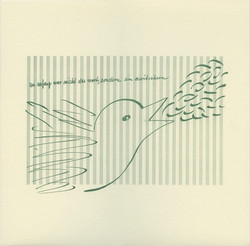
Booklet 16 pages (images/texts french/english)
Audio CD 40 minutes
limited edition of 100 copies
Recordings : june 2019 - october 2022
extra field recordings : 2003-23
Editings and mixings : Spring - Summer 2023