Eric La Casa, Seijiro Murayama
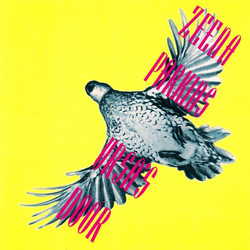
Paris Public Spaces 2
Tracked express shipping from Italy, no customs or import VAT in the EU. Shipping costs
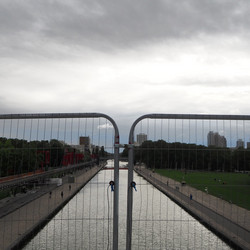
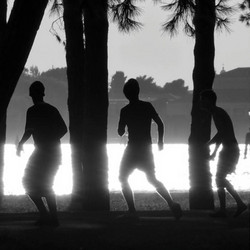
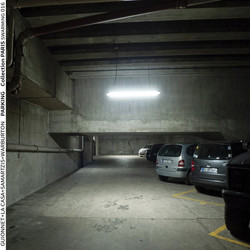
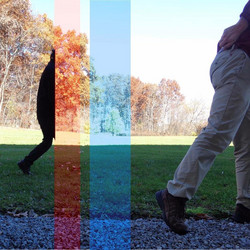
Tip! Paris Public Spaces 2 continues the collaboration between Éric La Casa and Seijiro Murayamaas a series of site-specific encounters rather than conventional “pieces.” Between May 20 and October 7, 2025, always between 3 and 5 p.m., the pair moved through Paris in twos, choosing locations that range from passages, squares and esplanades to parks, bridges and tunnels, stretching from the Bois de Vincennes out to La Défense. At each stop, Murayama’s voice enters the environment – sometimes as tone, sometimes as fragmentary language, sometimes as raw breath – while La Casa frames and follows it with a three‑channel microphone setup (ORTF pair plus wireless omnidirectional), treating the act of recording as a parallel performance.
The result is a catalogue of short interventions that foreground the city as a constantly shifting instrument. Murayama’s vocal actions bounce off masonry, disappear into foliage, are swallowed by traffic or cross‑talk; La Casa’s mixing makes those responses legible without ever forcing them into a fixed narrative. A tunnel turns a single syllable into a drawn‑out resonance, a plaza scatters consonants into the air, a park softens edges with distant leaves and children’s voices. By moving from site to site and keeping the temporal window narrow, the project catches a specific diurnal band of Parisian life, re‑heard through the filter of one voice and one listening body.
Rather than documenting “public space” as background, Paris Public Spaces 2 treats it as co‑author. The three‑channel recordings preserve directional information and local colour, giving each track a distinct spatial fingerprint while allowing the listener to sense an underlying continuity of method and attention. La Casa’s long-standing fascination with environmental sound and Murayama’s deep practice of vocal and percussive minimalism meet here in a stripped-down format: microphones, recordings, mixings on one side, voice on the other. Together they compose a subtle but precise study of how a city sounds when addressed directly – and how that address, in turn, briefly alters the space that receives it.
This edition
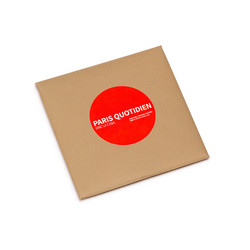
Edition of 150 copies. 24 pages Booklet included
Release notes
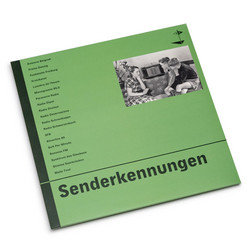
Booklet (24 pages of original text and photos) with audio CD Limited edition of 150 copies !
| 1 | Route | 4:38 | |
| 2 | Passages, Ruelles | 5:35 | |
| 3 | Ponts, Place Couverte | 7:55 | |
| 4 | Rue, Place, Esplanade | 6:48 | |
| 5 | Passage (intermède) | 2:19 | |
| 6 | Ponts, Tunnel | 9:32 | |
| 7 | Parcs | 7:12 | |
| 8 | Plaine | 4:18 |