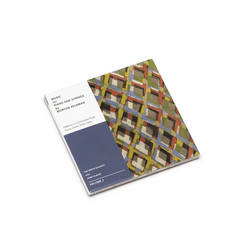
This CD is comprised of works from Feldman’s Early Period (late 40’s until the late 60’s) and Middle Period (late 60’s/ early 70’s until the early 80’s) of composing. In the beginning, like all young creative artists, Feldman was working through the influences he found alluring and the influence of his teachers, working for the moment that he would find his personal creative voice. With the previously recorded Only (on Etcetera, The Barton Workshop has now recorded all of the earliest works that Feldman chose to publish).
The first work on this CD, Journey to the End of Night (1949) shows unmistakable influences from his study with Stefan Wolpe yet it also shows a clear command of this musical language! It is a dramatically clear and forceful work. The text has been extracted, presumably by Feldman himself, from the long novel of the same title by Céline. The philosophy and critical stance of this text apparently struck a sympathetic chord with Feldman.
Although a student of Wolpe, Feldman was clearly heavily influenced by the work of Anton Webern. One hears the harmonic/melodic texture of Webern’s music not only in many of the notated works within the following 2 years of Feldman’s work, a period which includes the 4 Songs to e.e.cummings (1951), but to a large extent throughout Feldman’s entire oeuvre. This period of working through Webern was to prove seminal in Feldman’s artistic development, and the 4 Songs to e.e. cummings, with their extreme vocal demands, remind us firmly of Feldman’s fascination with the surface of Webern’s music.
In Intervals (1961), Feldman creates situations in which pitches or tonal colors will be picked up between the instruments-the texture could be described as a stasis or prolonged chord/color.
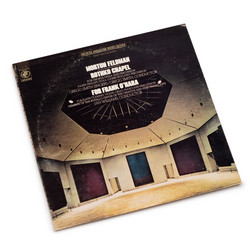
The O’Hara Songs (1962), notated in the same manner as Intervals, never uses all the instruments simultaneously with the singer. With regard to Frank O’Hara’s poem, Feldman uses it in its entirety, without any repetitions of words or phrases in the outer movements, while the inner movement uses only 5 repetitions of a single phrase of music/text: “Who’d have thought that snow falls”. It is a poem of striking tenderness, again revealing something almost contradictory about the often gruff, bear-like Feldman to us.
Four Instruments (1965), like The O’Hara Songs, is composed utilizing Feldman’s compositional/notational system wherein the players begin simultaneously but proceed at their own pace. In addition, Four Instruments and Between Categories, like the earlier Vertical Thoughts series, require the players to often listen carefully not only to the beginning and sustained parts of each note but also to play their next note just as another instrument is fading out. This is an extreme concentration upon the manner of beginning, sustaining and ending notes which no other composer has really explored. Such an extreme focus by each player must of course be matched with attentive listening by the audience.
Between Categories (1969) uses two identical ensembles separated in space. The ensembles, like most of his pieces from the 60’s, begin simultaneously, but in the case of ensemble 1, they begin with a silence! Through the use of two identical ensembles and shared materials (chords and arpeggiated material), Feldman underscores one’s sense of musical space.
In Three Clarinets, Cello and Piano (1971), Feldman was thinking of Cézanne, of painterly issues as they might apply to musical composition. The title is intentionally like the title of a still-life painting. This is considered a work in which he was returning to “flat textures”-he has set the melodic work of Clarinet 1 and the Cello off as foreground materials against the flat textures provided by the other instruments.
The superb performances come from The Barton Workshop, an Amsterdam based ensemble founded in 1989 by composer-trombonist James Fulkerson. The artistic philosophy of the ensemble is to perform the leading edge of contemporary music today. The Barton Workshop have a strong tradition of music by Wolff, Cage and Feldman. They have made many excellent recordings on the Etcetera label, this Feldman volume is their first of several to come dedicated to Feldman and Wolff.
Journey to the End of Night (1949) (2:11-1:12-1:00-2:37), for soprano, flute, clarinet, bass clarinet and bassoon (first recording)
4 Songs to e.e.cummings (1951) (0:41-0:32-1:17-0:45), for soprano, piano and cello
Intervals (1961) (1:17-3:15-1:58-2:39), for bass-baritone, trombone, cello, vibes and percussion (first recording)
The O’Hara Songs (1962) (3:09-2:32-2:41), for bass-baritone, chimes, piano, violin, viola and cello
Four Instruments (1965) (20:42), for chimes, piano, violin and cello
Between Categories (1969) (12:29), for 2 chimes, 2 pianos, 2 violins and 2 cellos (first recording)
Three Clarinets, Cello and Piano (1971) (9:32)
The Barton Workshop
James Fulkerson, trombone, conductor and director
Claron McFadden, soprano
Charles van Tassel, bass-baritone