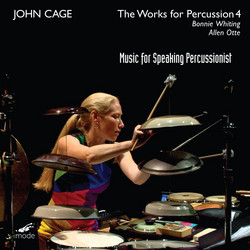
John Cage allowed some of his works to be combined and performed at the same time. On this disc percussionist Bonnie Whiting plays solo-simultaneous realizations of several of them for a "speaking percussionist".
51'15.657" for a speaking percussionist combines all of 45' for a speaker (1954) and 27'10.554" for a percussionist (1956). Music for Two (By One) comes from the series Music for___, written between 1984 and 1987, whose pieces can be performed alone or in any combination; Whiting combines a percussion version with the version for voice.
The programme is completed by two early pieces for voice and piano, The Wonderful Widow of Eighteen Springs (1942) and A Flower (1950), in which the piano is used as a percussion instrument, knocked and slapped rather than played on the keys. As a bonus, Allen Otte of Percussion Group Cincinnati, Whiting's mentor, performs his own work for speaking pianist/percussionist, built on Cage's works and compositional methods.
A Flower (1950) (3:40)
51'15.657" for a speaking percussionist (2010) (51:22)
Music for Two (By One) (2011) (13:38)
The Wonderful Widow of Eighteen Springs (1942) (2:52)
Allen Otte, Connecting Egypt to Madison through Columbus Ohio, Cage, and the History of the American Labor Movement (2011) (7:18)
Bonnie Whiting, voice, percussion
Allen Otte, voice, prepared piano, percussion
CD or Bluray. BLURAY version includes full video and 48khz/24-bit PCM audio + 73 minute video interview with Whiting and Otte, discussing Cage and his processes, the works and how they assembled them.