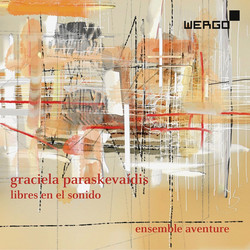
A portrait of the Argentinian composer Juan Carlos Paz by the Freiburg-based Ensemble Aventure, part of its long commitment to Latin American contemporary music. Four works from 1950 to 1964 trace his path from twelve-tone writing to graphic notation. Two of them, Invención and Concreción, are heard here in their first European performances and their first recordings anywhere.
For half a century Paz shaped the avant-garde in Argentina and Latin America as composer, concert organiser, musicologist, teacher and author, and he even appeared as a film actor. He was a founding member of the Grupo Renovación in Buenos Aires in 1929, then left to found his own series of new music concerts. He died in Buenos Aires in 1972. Ensemble Aventure was founded in Freiburg in 1986. Here it is joined by pianist Akiko Okabe and conducted by Alexander Ott. The disc is a coproduction with Deutschlandradio, supported by the Fundación Música AntiquaNova.
Dédalus, 1950, op. 46, for flute, clarinet, violin, cello and piano, marks a turning point. After years of adopting the twelve-tone technique, Paz takes it to a new level by following Webern's serial method. Invención (1961) for string quartet was commissioned by the University of Tucumán and written in less than six weeks. Its row consists of four groups of three notes, arranged so that the second half is the inversion of the first. Through counterpoint, variation and ostinato, ever new figures pursue one another. Núcleos (1962-64), his last solo work, is a highly virtuosic piano cycle. The first series, heard here in five parts, reconciles the opposing worlds that fed his personal style.
Concreción (1964) is scored for flute, clarinet, bassoon, trumpet, cornet, trombone and tuba. Paz uses a whole cosmos of compositional elements and graphic figures, typical of his late works and anticipating developments of the late 20th and 21st centuries. His influence rests on this range, from twelve-tone technique through metrical experiments and jazz to free concepts. It also rests on his contacts with the painters and writers of his time. The Schott text notes that hardly a Latin American composer today has escaped his influence.
CD, Wergo WER 7327 2, released in 2015, in Wergo's series with Ensemble Aventure.