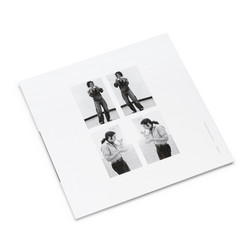
Giuseppe Chiari
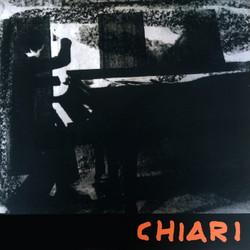
Il Metodo per Suonare (LP)
Tracked express shipping from Italy, no customs or import VAT in the EU. Shipping costs
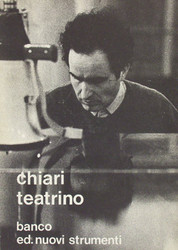
Mega Tip! Edition of 200 copies, comes with a large illustrated insert. Giuseppe Chiari arrived at music from the wrong direction. He read mathematics and engineering at university and studied piano and composition privately, and it was John Cage who turned him toward experimental music. With Pietro Grossi he founded Vita Musicale Contemporanea, one of the first Italian associations for new music, and with Sylvano Bussotti he assembled the travelling exhibition Musica e segno. In 1962 Frederic Rzewski performed his Gesti sul piano at the Fluxus Internationale Festspiele Neuester Musik in Wiesbaden, and Chiari joined Fluxus that year as its only official Italian member; the following year Charlotte Moorman and Nam June Paik programmed his Teatrino in New York. Documenta 5 came in 1972 and the Venice Biennale three times across the decade, and from then on his work belonged to galleries as much as to concert halls.
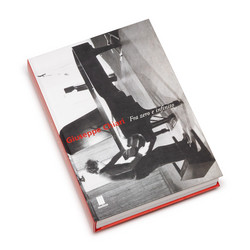
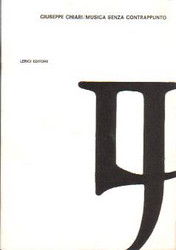
His Metodi per suonare, methods for playing, were written across the 1960s and reached the art world before they reached the music world. In 1976 Gillo Dorfles collected eleven of them in the book Il Metodo per suonare di Giuseppe Chiari (Martano Editore, Torino): methods for playing water, crackling objects, breaking, rattles, stones, the guitar, the piano, a video camera, a room, a city. The scores are verbal, graphic, or both, written in a private system of signs and drawings, and what struck readers at the time was as much visual as musical. Chiari showed them at the Rome Quadriennale in 1973 and performed them in galleries and festivals throughout the decade.
Pianist Chiara Saccone and cellist Deborah Walker have now recorded six of them, the first time any of the Methods have been committed to record in this form. Four come from Dorfles' book: I Sassi, La Chitarra, Il Rompere and L'Acqua. The other two are unpublished scores held in the Giuseppe Chiari Archive, the Metodo teorico e pratico per suonare il pianoforte (1964), thirty-one handwritten pages heliographed into an album, and its companion for cello (1962). Both are adaptations of earlier compositions, Gesti sul piano and Per tre archi, and both work as finished pieces, with a sequence of events fixed by the score and everything else left to the performer.
The rest are closer to invitations than to compositions. The Method for stones likens them to pyramids, dice, cones and cylinders in order to work out what sounds they make when moved by hand, and the word 'stone' covers any object that will sound that way. The Method for breaking opens with a definition of breaking load, sets out four shapes and five forces that can be applied to them, and ends with a warning that the force which breaks should make no noise. The Method for guitar starts by loosening the strings, or removing them, until the instrument can no longer be played in the usual manner. This is the other end of the body of work Alga Marghen opened earlier this year with Intervalli. Having finished that cycle in 1956, Chiari abandoned staff notation and never returned to it, and the Methods are where the decision leads: the performer is asked to lay hands on the instrument as if resting them on any object, to forget position and technique, to treat a cello as wood and metal with parts and shapes. Striking, rubbing, stroking and tapping the body of the instrument take the place of playing it. What sounds simple in 2026, after decades of extended technique, was written down in 1962 by a composer with no contact yet with the visual art world, and Chiari's insistence on formalising it in writing is still the strangest thing about these pieces.
Saccone has worked on Chiari since 2012, performing Suonare la stanza for Centro Pecci in 2017; Walker plays with Dedalus and ONCEIM and has worked with Éliane Radigue, Pascale Criton, Catherine Lamb and Phill Niblock. They began on the Methods together in 2019 with the encouragement of Chiari's family, through residencies at GMEA in Albi, workshops and conversations with other musicians, and their essay on that process is included with the record.
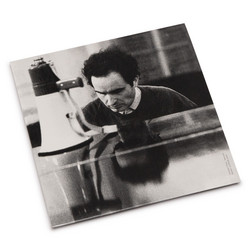
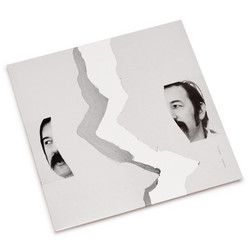
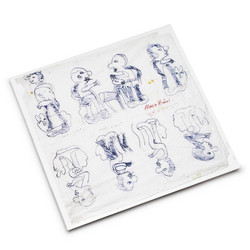
Recorded between 2021 and 2025 in Berlin, Albi, Montespertoli and Florence. Mixed by Adam Asnan and Sam Dunscombe, mastered by Giuseppe Ielasi. Project coordination by Gabriele Bonomo, the musicologist behind Charlotte Moorman's Cello Anthology and Henri Pousseur's Paysages planétaires for Alga Marghen and the Roland Kayn reissues on Die Schachtel, who also wrote the notes for Intervalli and introduced Saccone's performances of Gesti sul piano in 2019, while Chiari's videotapes were undergoing restoration. The insert reproduces pages from the scores alongside photographs of Chiari and of the performances.