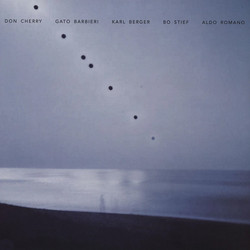
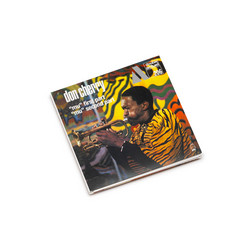
Togetherness documents a pivotal moment in Don Cherry’s evolution, catching him in Paris in the spring and summer of 1965 leading his first steady working band after the Ornette Coleman years. Issued on Durium in 1966 and later rebranded under both Cherry and Gato Barbieri’s names, the album presents a five‑movement composition – “Togetherness One” (movements I–III) and “Togetherness Two” (movements IV–V) – performed by a quintet that would exist only briefly but leave a deep imprint. Alongside Cherry’s cornet, the group features Barbieri on tenor saxophone, Karl Berger on vibraphone, Jean‑François Jenny‑Clark on bass and Aldo Romano on drums.
The Togetherness suite had been gestating for several years as a loosely framed sequence of themes and cells that Cherry would thread through concerts and recordings; fragments surface under other titles across his mid‑60s work. Here it appears as a continuous structure whose movements string playful, chant‑like heads together with free yet melodically grounded solos. Berger later recalled that with this band “there was no need to talk about style… Everything we later played evolved collectively,” a sentiment borne out in the music’s balance of freedom and cohesion. Rather than the anger often associated with early free jazz, the group projects an almost dancing energy, even at its wildest.
Critics have long singled out Barbieri’s presence. Scott Yanow noted that while Cherry plays “pretty free,” he can sound conservative next to Barbieri’s often violent wails and overblown cries. Kevin Le Gendre has described the album as a marker of Barbieri’s arrival as a major avant‑garde voice, his raw, vocalised tenor cutting through the ensemble with ferocious focus. Cherry, by contrast, moves between clipped fanfares, folk‑like motifs and extended lines that hint at the global, modal directions his later music would pursue. Berger’s vibes add an unusual transparency to the texture, sketching harmonies without pinning the music down, while Jenny‑Clark and Romano provide a mobile, springy foundation, alternately swinging, splashing and suspending time.
Across its five movements – ranging from just over five minutes to more than twelve – Togetherness feels less like a sequence of tunes than like a single, breathing suite, always on the verge of flying apart yet held together by shared material and a collective sense of form. Bob Blumenthal, writing in The Rolling Stone Jazz Record Guide, called it “a confident recital,” praising how the pieces “string playful themes together with solos that are free yet convey joy instead of the then prevalent anger.” That joy, sharpened by risk, is the album’s lasting signature.