Steve Roden
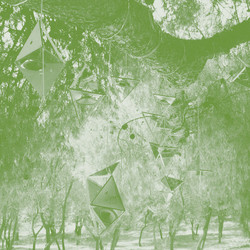
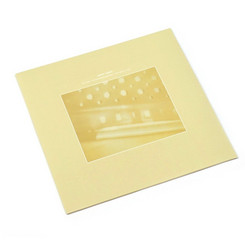
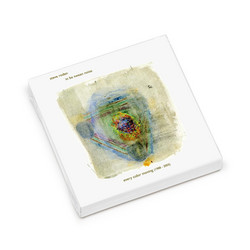
A Thousand Breathing Forms (7CD Box)
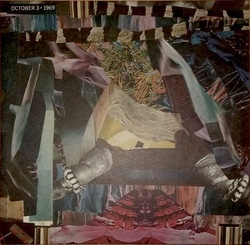
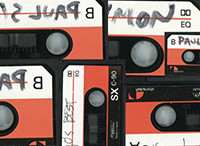
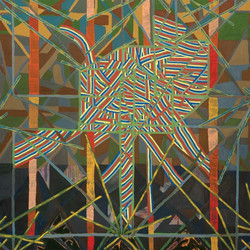
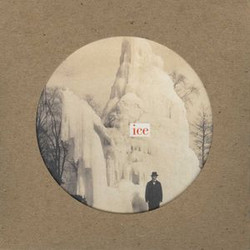
** 2026 Repress ** A Thousand Breathing Forms is the second major volume of archival work by Steve Roden issued by Sonoris, and it focuses on a particularly fertile stretch: 2003 to 2008, a period when his ideas about loops, sources and “possible landscapes” reached a rare density and clarity. Where the earlier Every Color Moving box documented the first fifteen years of his sound practice, this set turns to a middle phase in which his language is fully formed yet still constantly testing its own edges. Comprising unreleased or extremely hard‑to‑find works from those years, it offers a deep immersion in the loop‑based pieces that are so uniquely his - pieces like Stars of Ice or A Christmas Play for Joseph Cornell - alongside more overtly conceptual constructions such as One hour as the bumps of surfaces and several more “musical” or instrumental works that foreground harmony and phrasing a little more than usual.
“So delicate and strangely made,” the title of one of Roden’s earliest records, still feels like the most accurate shorthand for what is happening here. His sound work is rooted in visual art and architecture, and that is audible in the way these pieces handle structure, negative space and surface detail. Loops don’t behave like simple repetitions; they act more like architectural modules or painted marks, placed and slightly varied until a larger form emerges almost imperceptibly. Across the six discs, small cells of sound - a plucked string, a crackle, a vowel, a room tone - are set spinning and gently nudged, producing slow, breathing shifts in colour and density. The music feels fragile yet stubborn, modest in gesture yet quietly insistent in presence.
Roden (1964–2023), born in Los Angeles, worked across painting, drawing, sculpture, film and video, sound installation and performance. That breadth was not a matter of dabbling but of a single sensibility moving through different media. In sound, he tended toward using singular sources: objects, architectural spaces, field recordings or texts. These would be subjected to humble electronic processes - light filtering, looping, layering, time‑stretching - and in the process become abstracted into new audio spaces he called “possible landscapes.” In A Thousand Breathing Forms, this methodology is applied with particular intensity. Many of the pieces are constructed from tiny, often unidentifiable fragments: a scrap of a record from another culture, an off‑mic clink, a whispered consonant, a piano note barely struck. Yet the resulting works feel organic, almost tactile, as if grown rather than produced.
An accompanying text describes Roden as a “singular voice, attacking and advancing the highest challenges of the avant‑garde – blurring the lines between nearly every creative field, moving outwardly toward the boundary with everyday life.” That description comes into focus here. A pioneer of lowercase music, he made a practice of amplifying the quiet and unheard sounds of objects and environments, not as a stunt but as a way of honouring the beauty and complexity of the everyday. In doing so, he extended and re‑framed ideas associated with John Cage: not simply chance and indeterminacy, but the deeper proposition that non‑instrumental sources and ordinary situations can be as worthy of attention as any “musical” material. Through subtle intervention rather than spectacle, Roden opened a path for a generation of sound artists who refuse clear categorisation and move as comfortably in galleries and museums as in music contexts.
Across A Thousand Breathing Forms, that lineage is audible but never didactic. Guided by rigorous conceptual parameters - self‑imposed rules about source material, duration, or process - Roden nonetheless lets the work remain drenched in musicality. The loop‑based pieces draw “democratically from a seemingly endless world of source”: records from disparate cultures, field recordings, instruments, objects, environments. Electronic processing is present but never showy; it serves to coax, blur and nudge, not to overwhelm. For all their electronic origins, these pieces sound startlingly organic: steeped in touch, breath and the small hesitations of hand‑made craft. They invite inhabitation rather than analysis, burrowing deep into the ear until their patterns feel like part of one’s own internal weather.
As these resonances and structures intertwine, Roden appears simultaneously as a bridge to the past and a vision of a possible future. His work quietly reconciles tensions between minimalism’s focus on reduction and repetition, and the conceptualism associated with John Cage and visual art practice. Ideas guide the pieces, but the listener always meets them as sound first: gently shifting chords, faint rhythmic lattices, clusters of microscopic events. Mastering by Giuseppe Ielasi preserves this balance, maintaining the subtle dynamics and low‑level detail that make the work breathe. Over six CDs, A Thousand Breathing Formsbecomes both a lens into the practice of an artist of rare significance and an opening onto a broader field: a collection that captures and advances some of the most demanding ideas in experimental sound with an ease, accessibility and grace that continue to deepen with every listen.