Steve Roden
Every Color Moving (1988-2003) (6CD Box)
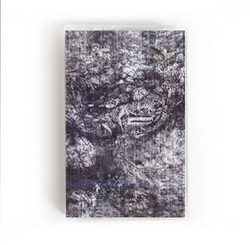
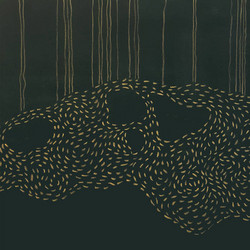
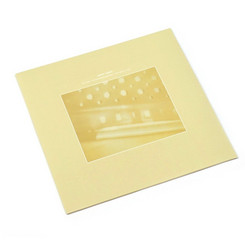
** 2026 Repress ** Every Color Moving (1988–2003) is an extended encounter with the formative years of Steve Roden, tracing how a former Los Angeles punk singer slowly tuned his practice down to a whisper and, in the process, helped define an entire strain of quietly obsessive sound work. Spanning six discs and around seven hours of audio, the collection covers the first 15 years of his musical activity. The first four discs gather impossible‑to‑find small editions and previously unreleased works; the final two compile tracks made for compilations over the same period. Taken together, they map Roden’s movement from raw early experiments toward the fragile, detail‑rich “lowercase” aesthetic that would become so widely imitated and yet remain unmistakably his.
The set is accompanied by a 32‑page booklet featuring an essay and extensive track notes written by Roden himself, offering insight into the sources, processes and circumstances behind these recordings. That context matters, because Roden’s sound practice was always entwined with his life and with his work in other media. Born in Los Angeles in 1964, he was an artist in the broadest sense: painting, drawing, sculpture, film and video, sound installation and performance formed a single, interwoven field. His earliest musical experience was as the singer of Seditionaries, a punk band active in the Los Angeles scene from 1978 to 1982, sharing stages with groups that would later become canonical. Those years of volume and abrasion left their mark, but his trajectory would bend sharply in another direction.
In the midst of an emotional crisis at 18, Roden’s work shifted from loud to quiet. The discovery of Brian Eno’s Obscure label opened a door onto music that could be experimental without bombast, conceptual without sacrificing feeling. In the early 1990s, encountering the Broken Music catalogue - an encyclopedic survey of records made by visual artists - gave him a framework for understanding how sound and visual practice might feed one another. From that point on, his output can be heard as a continuous dialogue between these fields, each recording a kind of drawing in time, each painting or sculpture an analogue to his “possible landscapes” in sound.
Roden’s first release under the name in be tween noise arrived in 1990 as a self‑released cassette titled the secret of happiness. It set the tone for much of what followed: modest means, focused listening, a refusal to separate concept from intuition. Over the next decade and a half he would issue 45 solo recordings across various labels, alongside numerous collaborations and compilation appearances. By the late 1990s he had gradually shifted from the in be tween noise moniker to using his own name, signalling the consolidation of a voice that no longer needed an alias. Every Color Moving moves through this period in detail, letting listeners hear how ideas seeded on tiny runs of cassettes and CDs gradually crystallised into a coherent language.
A hallmark of Roden’s sound work is the use of singular sources: a set of objects, an architectural space, a handful of field recordings, a text. Rather than stacking myriad elements, he would take one thing and subject it to a series of humble electronic processes - looping, filtering, slowing, layering subtle transformations over time. In doing so, he abstracted the source just enough to open it up, creating new audio spaces that hover between recognition and erasure. He often described these as “possible landscapes”: environments you could mentally inhabit, built from the smallest of gestures. Throughout Every Color Moving, you can hear that approach being discovered and refined, as noisy edges gradually soften and attention shifts inward, toward minute changes in texture, timbre and resonance.
In 2000, Roden introduced the term “lowercase” to describe a music that “bears a certain sense of quiet and humility.” It was never meant as a genre label, but rather as a position: a commitment to small sounds, to restraint, to listening as an active, almost devotional practice. The works collected here document the emergence of that stance from a background of post‑punk restlessness and art‑school curiosity. Early pieces may be more overtly experimental or rough‑hewn; later ones are distilled to near‑silence, yet carry an intensity that comes from the listener being drawn into their micro‑events. Across all six discs, what stands out is Roden’s mix of conceptual rigour, willingness to experiment and deep musicality. Every Color Moving is not just an archive; it is a long, quietly luminous portrait of an artist teaching himself how to transform the smallest sounds into entire worlds.