Jan Garbarek Quartet
Afric Pepperbird
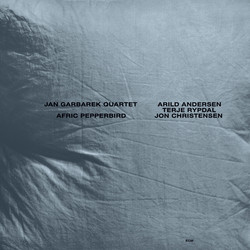
CD version. Recorded in Oslo in September 1970 and released on New Year's Day 1971, Afric Pepperbird brought four young Norwegians to the new ECM label. They were saxophonist Jan Garbarek, guitarist Terje Rypdal, bassist Arild Andersen and drummer Jon Christensen. It is among the fiercest records of Garbarek's career, a free jazz album in the wake of John Coltrane. It also marked the start of associations with the label that would last for decades.
The quartet worked over two days, 22 and 23 September 1970, at the Arne Bendiksen Studio in Oslo. Manfred Eicher produced, and the engineer was Jan Erik Kongshaug, then new to the studio. Garbarek plays tenor and bass saxophones, clarinet, flutes and percussion. Rypdal adds a bugle to his guitar, and Andersen moves between double bass, African thumb piano and xylophone. Garbarek wrote four of the eight pieces, Andersen three, and Christensen the closing Blupp.
The album opens quietly. In Skarabee a thumb piano and a sparse cymbal introduce a slow, weary theme played high on the tenor, with Rypdal floating behind it. Beast of Kommodo is the long centre, more than twelve minutes of riffing and hard soloing over a relentless pulse from Andersen and Christensen. Rypdal often holds the middle with taut chords. Between the long tracks sit Andersen's miniatures Mah-Jong, MYB and Concentus, none of them two minutes long. The title track doubles saxophone and guitar on a riff and brings in the rumble of the bass saxophone.
The first reviews were enthusiastic. Writing in DownBeat in 1971, Joe Klee called the playing "full of jagged edges and beautiful surprises, Coltrane-influenced but his own." In Melody Maker the same year, Richard Wright noted that on Beast of Kommodo Garbarek "almost seems to be talking through the tenor." Later critics hear the record as a document of the years before Garbarek turned towards Nordic folk melody and the spacious sound now linked with ECM. Listeners who know only his later work tend to be surprised by its energy.
This CD reissue keeps the original catalogue number ECM 1007 and the complete eight-track programme of the 1971 album.