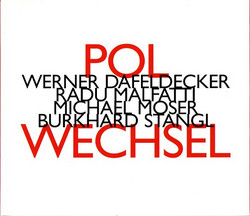
**2026 Stock** Embrace 4: Orakelstücke/Aquin places Polwechsel inside two distinct compositional worlds while keeping their own microscopic listening at the centre. Side A, Orakelstücke, comes from Peter Ablinger, whose work often focuses on the grain of everyday sound and the rituals hidden in repetition. Here, Ablinger treats isolated percussive strikes, feedback and fragile vocal traces as if they were small devotional objects - touchstones passed from hand to hand. Michael Moser (cello, voice, objects), Werner Dafeldecker (double bass, voice, objects), Burkhard Beins (feedback microphone, voice, objects) and Martin Brandlmayr(vibraphone, voice, objects) articulate an “identical theme” at the opening and close of the piece, but what happens in between is a slow, searching divination of its components: tiny hits, resonances and breaths suspended in a charged silence that turns common materials into something oracular.
The “mystery in the everyday” that critic Stuart Broomer hears in Orakelstücke runs through the whole of side A. The players handle their instruments and objects with the same attention a pilgrim gives to rosary beads or pocket stones. Single vibraphone notes hang in the air like questions; feedback tones arrive as hair‑thin lines, then thicken; the grain of voices slips between utterance and pure timbre. The music never rises above a modest dynamic, yet it feels full of latent weight, as if each modest event might tip the balance of the whole. Recorded in December 2022 by Sebastian Pracher at Spielzimmer in Bad Goisern, the piece captures Polwechsel and Ablinger finding a shared space where composition becomes a framework for collective auscultation: listening to objects, rooms and the tiny differences between one strike and the next.
Side B, Aquin, shifts the focus from discrete gestures to sustained duration. Written by Klaus Lang and performed by Polwechsel with the composer on harmonium and flute, the piece unfolds as a long, slowly evolving field of sound in which historical time and musical time seem to blur. Lang’s harmonium lays down gently beating chords that suggest just‑intonation relationships, while cello (Moser), double bass (Dafeldecker) and the twin percussionists (Beins and Brandlmayr) weave in tones, scrapes and soft attacks that feel both medieval and faintly spectral. The sense of duration is not just a matter of length; it’s the way tones are allowed to fully bloom and decay, how each new pitch seems to arrive out of, and return to, a much older resonance.
Broomer notes how Aquin seems to invoke an ancient ecclesiastical vision of justice and community, its patient harmonies echoing through to present circumstances. You hear this in the music’s refusal of drama in favour of persistence: chords that shift by degrees, intervals that shade from pure to rough, percussion that often registers more as breath or distant machinery than as conventional rhythm. Recorded live in November 2020 by Martin Leitner at ORF Sendesaal in Vienna during the Festival Wien Modern, the performance captures the ensemble as a single, breathing organ, Lang’s harmonium and flute entwined with Polwechsel’s finely calibrated ensemble blend.
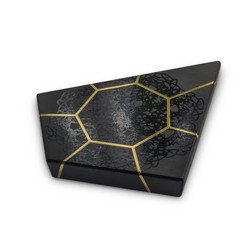
Both works are mixed and mastered with the group’s customary care: Aquin mixed by Wolfgang Leitner and both sides mastered by Wolfgang Musil, preserving the full dynamic arc from near‑inaudibility to quiet fullness. Visually, the LP is framed by artwork from Teresa Iten and cover art by Michael Moser, extending the music’s attention to texture, fracture and continuity into graphic form.
Taken together, Orakelstücke and Aquin show Polwechsel in a state of porous focus: opening their practice to external compositional voices while remaining unmistakably themselves. Everyday strikes become ritual markers; long tones become carriers of memory and possibility. Embrace 4 thus stands as both a continuation of the series’ inquiry into collaboration and a quietly monumental statement in its own right - chamber music pared back until it brushes against the sacred.