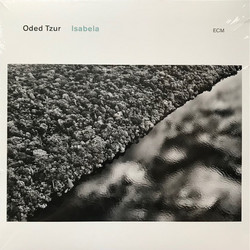
CD version. Isabela is the second ECM album by the New York-based tenor saxophonist Oded Tzur. It pushes further the idea that made his debut stand out, a meeting of jazz and Indian raga in which neither tradition is borrowed as mere colour. Here one self-fashioned raga runs through a suite-like sequence of five pieces, lasting about 36 minutes, that moves between quiet meditation and powerful outbursts.
Tzur was born in Tel Aviv and studied Indian classical music with the bansuri master Hariprasad Chaurasia. His quartet is the same one heard on Here Be Dragons from 2020: Nitai Hershkovits on piano, Petros Klampanis on double bass and Johnathan Blake on drums. The album was recorded in 2021 at the Auditorio Stelio Molo RSI in Lugano, in collaboration with the Swiss radio channel RSI Rete Due. Stefano Amerio was the engineer and Manfred Eicher produced.
Each of the five pieces approaches the underlying raga from a different angle. The opening Invocation works like a chalan, the compact outline of a raga: a rubato of under two minutes that swells to an arresting crescendo. Noam follows with a yearning melody of folk-like simplicity. Reviewers heard The Lion Turtle as the centre of the record. It builds slowly, with Blake lightly tapping the edges of his kit and the bass and piano solos closely linked. The title track starts quietly, passes through a driving passage and settles into something gentler. Love Song for the Rainy Season is the most energetic section, with the tenor entering on a torrent of knotty lines.
In Jazzwise John Fordham compared Tzur's sound to Jan Garbarek's in the early 1970s, noting that he "favors timbre and tonal nuance over postboppish loquacity." David Bruggink of All About Jazz called the album "a high water mark for ECM in the new decade." Several critics remarked on its brevity and found the short running time a strength, among them Tyran Grillo, who heard the album as a case of quality over quantity.
CD edition, ECM 2739, released in May 2022, with a cover photograph by Sebastião Salgado and a poem by Tzur in the booklet.