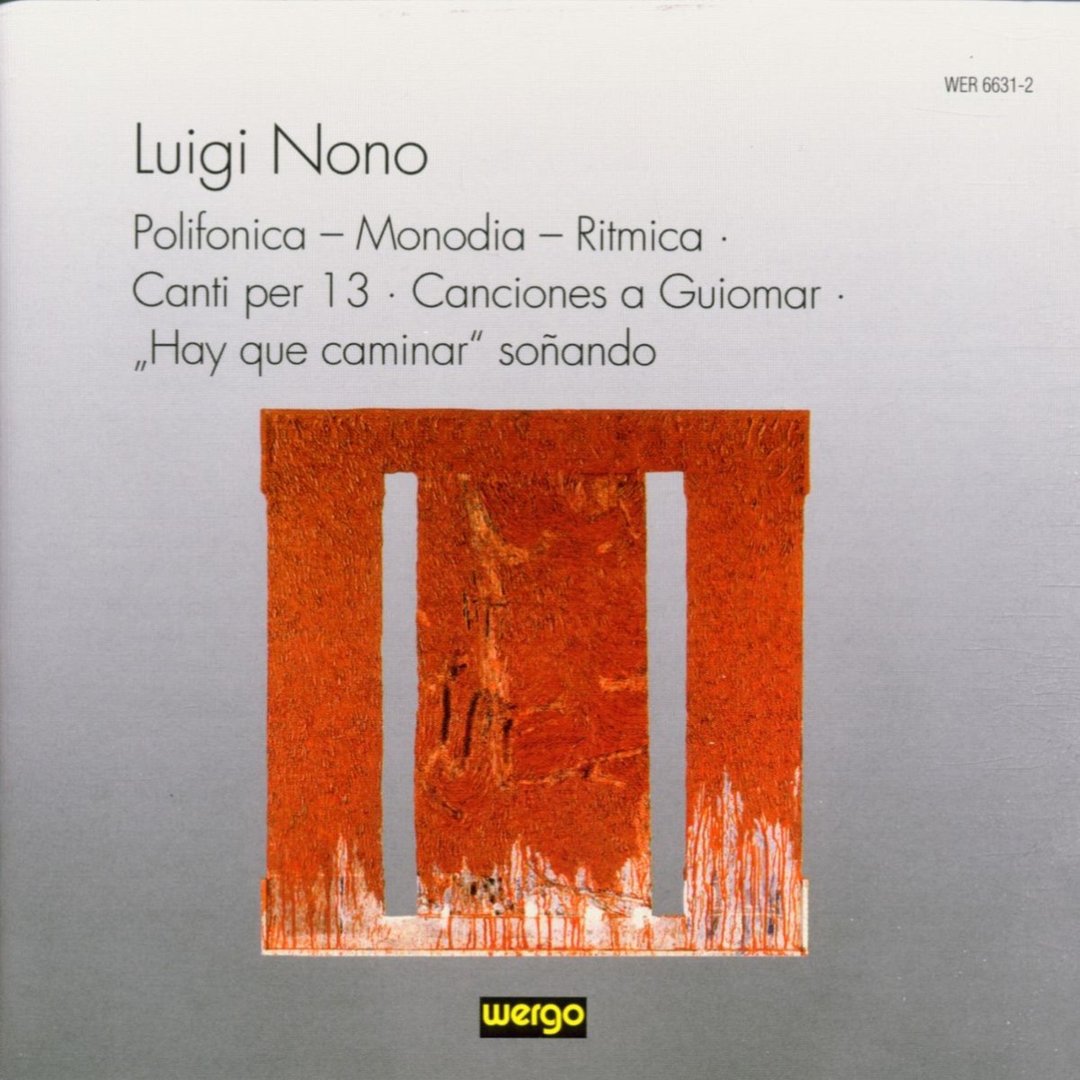
Luigi Nono
Polifonica - Monodia - Ritmica / Canti per 13 / Canciones a Guiomar / Hay Que Caminar Soñando
FormatCDLabelWergoGenreComposition
Arriving from the supplier: On backorder (ships as soon as it reaches us)
Tracked express shipping from Italy, no customs or import VAT in the EU. Shipping costs
This disc traces the idea of song through the work of Luigi Nono, from his Darmstadt debut of 1951 to "Hay que caminar" soñando, his last composition, written in 1989. Between them stand Canti per 13 (1955) and the Canciones a Guiomar (1962-63). The label points to the seam between Nono's early and late sound worlds, and to how closely the two are related.
Nono was an Italian composer, born in Venice on 29 January 1924 and died there on 8 May 1990. The performers are the Ensemble UnitedBerlin and the women's voices of United Voices, with the soprano Angelika Luz, conducted by Peter Hirsch. Martin Demmler produced the recording, Wolfgang Hoff recorded it and Ricarda Molder mastered it.
Polifonica-Monodia-Ritmica (1950-51), dedicated to Eunice Catunda, is scored for flute, clarinet, bass clarinet, alto saxophone, horn, piano and percussion. A reduced version was first heard in Darmstadt on 10 July 1951 under Hermann Scherchen. The full eighteen-minute version waited until 1997, when Ex Novo played it in Venice under Diego Masson; at ten minutes, the performance here matches the length of the reduced score. Canti per 13 is written for thirteen players, soprano saxophone and five-string double bass among them. It is dedicated to Pierre Boulez "per la sua umanità" and was premiered at the Domaine musical in Paris in March 1955. The Canciones a Guiomar set Antonio Machado for soprano, women's chorus, percussion, celesta, guitar, viola, cello and double bass. They were first performed in London in February 1963, with Dorothy Dorow as soloist and Nono conducting.
"Hay que caminar" soñando, for two violins, takes its title from a phrase Nono found on a cloister wall in Toledo: "Caminantes, no hay caminos, hay que caminar". It completes a triptych with Caminantes... Ayacucho and No hay caminos, hay que caminar... Andrei Tarkovskij. The two players move between several music stands placed around the space and come together gradually as they walk. Their material is the "enigmatic scale" of the string quartet Fragmente-Stille, An Diotima, played with almost no vibrato. Irvine Arditti and David Alberman gave the premiere in Milan on 14 October 1989.
CD, Wergo WER 6631 2, released in 1998, total time 57'52".
Release notes
"Polifonica-Monodia-Ritmica" for 6 instruments and percussion, composed in 1951. "Canti Per 13" for 13 instruments, composed in 1955. "Canciones A Guiomar" for soprano solo, 12-voices female chorus and instruments, composed in 1962-63. "'Hay Que Caminar' Soñando" for 2 violins, composed in 1989 (his last composition).
| 1 | Polifonica-Monodia-Ritmica | 9:59 | |
| 2 | Canti Per 13 | 10:55 | |
| 3 | Canciones A Guiomar | 9:54 | |
| "Hay Que Caminar" Soñando | |||
| 4 | Erster Teil | 6:15 | |
| 5 | Zweiter Teil | 9:46 | |
| 6 | Dritter Teil | 10:40 | |
- Knut Müller
- Artwork
- Luigi Nono
- Composed By
- Ricarda Molder
- Mastered By
- Martin Demmler
- Producer
- Wolfgang Hoff
- Recorded By


