Krzysztof Penderecki
Seven Gates of Jerusalem
FormatCDLabelWergoGenreComposition
Arriving from the supplier: On backorder (ships as soon as it reaches us)
Tracked express shipping from Italy, no customs or import VAT in the EU. Shipping costs
Seven Gates of Jerusalem is Krzysztof Penderecki's Seventh Symphony, written for five soloists, a narrator, three mixed choirs and orchestra on a commission for the celebrations of Jerusalem's third millennium. This disc is the first recording of the original version, with Part VI, a reading from chapter 37 of the Book of Ezekiel, recited in Hebrew. It was recorded live in Vienna on 16 November 1999.
Penderecki first passed through the gates of Jerusalem in 1974, on an unofficial visit to Israel, and returned several times. In 1987 he received the prize for music of the Wolf Foundation. The commission came in 1995, with the support of the mayor Teddy Kollek among others. The premiere took place in Jerusalem on 9 January 1997. Here Kazimierz Kord conducts the National Philharmonic Orchestra Warsaw and the National Philharmonic Choir Warsaw, prepared by Henryk Wojnarowski. The soloists include the sopranos Bożena Harasimowicz-Haas and Izabella Kłosińska, the tenor Wiesław Ochman and others, with Boris Carmeli as narrator. The concert took place in the Großer Saal of the Musikverein.
The number seven runs through the score. There are seven movements, setting Latin texts such as Magnus Dominus et laudabilis nimis, De profundis and Lauda, Ierusalem, Dominum. The main themes of the second and fourth movements, both on Si oblitus fuero tui, Ierusalem, have seven different notes and generate passacaglia-like structures. Groups of seven quarter notes repeated on a single pitch recur throughout, and the work ends with seven fortissimo chords.
Penderecki, the Polish composer and conductor, was born in Dębica on 23 November 1933 and died in Kraków on 29 March 2020. He studied composition in Kraków with Artur Malawski and Stanisław Wiechowicz. The premiere of Strophen at the Warsaw Autumn in 1959 made his name, and works such as Threnody to the Victims of Hiroshima (1960) and the St Luke Passion (1966) made it international. Later he moved from the clusters and extended techniques of those years to a neo-tonal, post-romantic idiom, while religious subjects stayed central throughout. He had already written five symphonies and had a sixth planned when he chose a vocal work for the commission and called it his Seventh Symphony. The booklet holds essays by Wolfram Schwinger, biographies of the performers and the libretto in Latin and Hebrew with translations in German, English and French.
CD with a 76-page booklet in a slipcase, Wergo WER 6647 2, released in 2000, licensed from CD Accord.
Release notes
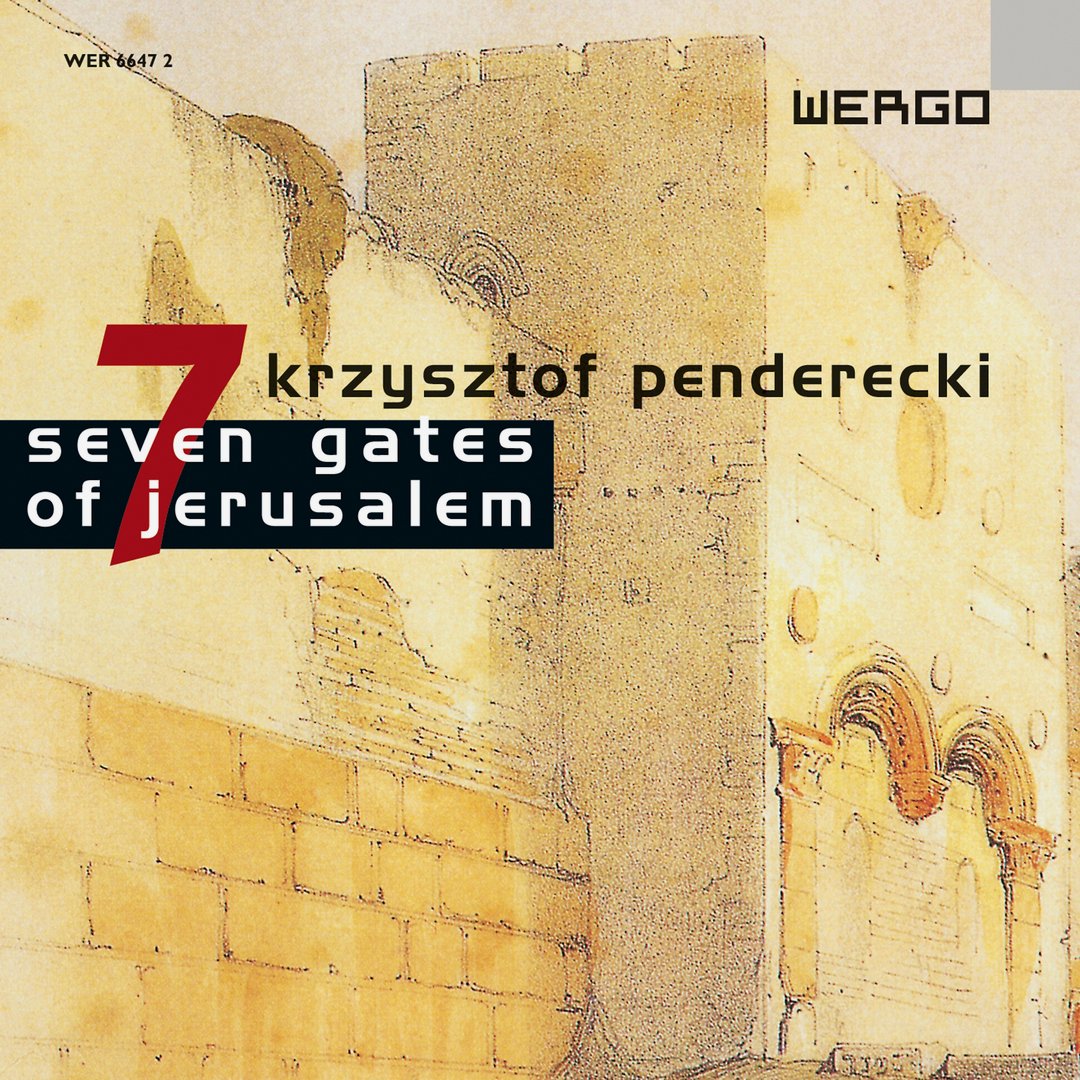
Symphony No. 7 for five soloists, speaker, three mixed choirs and orchestra (1996) © 1996 Schott Musik International, Mainz Ersteinspielung der Originalversion Live-Aufnahme: 16. November 1999, Wien, Musikverein (Großer Saal) Licensed by CD Accord Fotos: Schott-Archiv Cover-Abbildung: The Golden Gate of the Temple (1839) © all texts included: Schott Music & Media GmbH © + ℗ 2000 WERGO, a division of Schott Music & Media GmbH, Mainz, Germany Manufactured and printed in Germany Packaging:…
| Seven Gates Of Jerusalem (Symphony No. 7) | |||
| 1 | Part I: Magnus Dominus Et Laudabilis Nimis | 10:57 | |
| 2 | Part II: Si Oblitus Fuero Tui, Jerusalem | 2:53 | |
| 3 | Part III: De Profundis | 6:10 | |
| 4 | Part IV: Si Oblitus Fuero Tui, Jerusalem | 5:18 | |
| 5 | Part V: Lauda, Jerusalem, Dominum | 16:03 | |
| 6 | Part VI: היתה עלי ידיהוה [Hajetà Alai Jad Adonài] | 5:49 | |
| 7 | Part VII: Haec Dicit Dominus: Ecce Ego Do Coram Vobis Viam Vitae, Et Viam Mortis | 11:19 | |
- Jadwiga Rappé
- Alto Vocals [Alto] (1, 5, 7)
- Romuald Tesarowicz
- Bass Vocals [Bass] (1, 5, 7)
- National Philharmonic Choir Warsaw
- Choir
- Henryk Wojnarowski
- Chorus Master [Einstudierung]
- Krzysztof Penderecki
- Composed By
- Kazimierz Kord
- Conductor [Leitung]
- David Roberts
- Cover, Illustration [Cover-Abbildung]
- Beata Jankowska-Burzyńska
- Edited By [Schnitt], Engineer [Toningenieure]
- Andrzej Sasin
- Engineer [Toningenieure]
- Wolfram Schwinger
- Liner Notes
- Steven Lindberg
- Liner Notes [English Translation]
- Martine Paulauskas
- Liner Notes [Traduit Par]
- Julita Emanuiłow
- Mastered By [Mastering]
- National Philharmonic Orchestra Warsaw
- Orchestra
- Peter Andersen
- Photography By [Fotos S. 13, 21, 30]
- Katharina Freiberger
- Photography By [Fotos S. 6]
- Bożena Harasimowicz-Haas
- Soprano Vocals [Soprano] (1, 5, 7)
- Izabella Kłosińska
- Soprano Vocals [Soprano] (2, 4, 5, 7)
- Wiesław Ochman
- Tenor Vocals [Tenor] (1, 5, 7)
- Boris Carmeli
- Voice [Speaker] (6)