James Tenney
Postal Pieces 2 (LP)
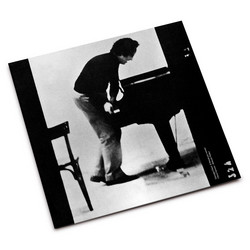
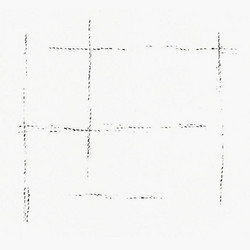
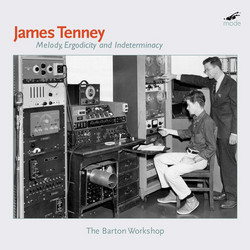
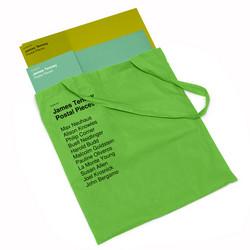
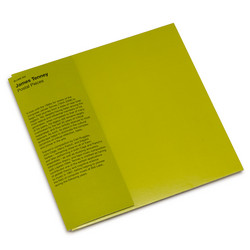
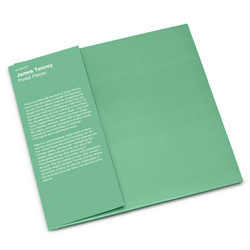
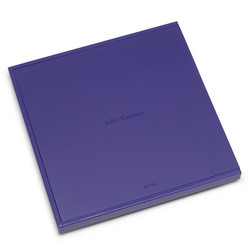
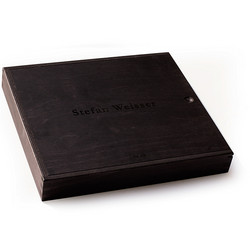
** 300 copies. Color Vinyl. 140gr Audiophile pressing. Including printed inner sleeve housing a Nagaoka anti-static record sleeve, plus an original insert that functions as Obi. Comes with exact replicas of the original postcard graphic scores. ** Following the first ever vinyl release to attend to James Tenney's Postal Pieces, Blume returns with a second volume from the seminal American composer's suite of eleven works, among the most important and quietly radical efforts of 20th Century experimental music. Since its founding in 2014, Blume has issued free-standing works, spanning the historical and contemporary, that represent singular gestures of creativity within the field of experimental sound, building networks of context and understanding that already include works by Werner Durand, Sarah Hennies, Bruce Nauman, John Butcher, Jocy de Oliveira, Mary Jane Leach, Valentina Magaletti, Alvin Curran, Julius Eastman, Alvin Lucier, Jürg Frey, Doris Dennison, Ben Vida, and others. This new collection marks the first appearance on vinyl of four more pieces from the suite - Swell Piece, for Alison Knowles (1967), Swell Piece #2, for Pauline Oliveros (1971), Swell Piece #3, for La Monte Young (1971), and Koan, for Malcolm Goldstein (1971) - drawing upon recordings by the Amsterdam based ensemble The Barton Workshop, under the direction of James Fulkerson, and features newly commissioned liner notes by Bradford Bailey.
In 1970, Tenney reversed the entropy of his own life and went west. Born in New Mexico, and raised between Arizona and Colorado, he had spent the majority of the post-war years at the centre of cultural ferment in New York. Far from self-sabotage, his generous spirit and radical temperament compelled him toward one of the great social experiments of the era. Alongside the interdisciplinary artists Allan Kaprow, Simone Forti, John Baldessari, Miriam Schapiro, Nam June Paik, and Alison Knowles, and the composers Morton Subotnick, Harold Budd, and Charlemagne Palestine, among numerous others, Tenney accepted a position at the newly inaugurated California Institute of the Arts (CalArts), embarking upon a revolutionary approach to arts education loosely based on Black Mountain College. While the move began an enduring period of relative obscurity, Tenney quietly remained one of the most distinct and groundbreaking composers of his generation, producing a remarkably focused body of work inquiring after the elemental character and perception of sound.
First encounters with the work of James Tenney tend to provoke states of wonder and confusion. For the relative obscurity that continues to haunt it, one could easily imagine his music to have been written by a hermetic maverick. Tenney was the opposite: a figure whose life and work represent a winding thread connecting the entire history of American avant-garde and experimental music, across multiple disciplines. He studied composition with Carl Ruggles, John Cage, Harry Partch, and Edgard Varèse, remaining close to all of them and later performing in Cage and Partch's ensembles, as well as acoustics, information theory, and tape music composition with Lejaren Hiller. His 1961 master's thesis, Meta-Hodos, became one of the earliest and most influential applications of gestalt theory and cognitive science to music. He went on to teach John Luther Adams, Raven Chacon, Peter Garland, Catherine Lamb, Ingram Marshall, Marc Sabat, Carl Stone, Tashi Wada, and numerous others.
During the 1960s alone, Tenney was an active member of Fluxus; collaborated and played with Max Neuhaus, La Monte Young, Steve Reich, Philip Glass, Michael Snow, Terry Riley, and many others; starred in and composed music for Stan Brakhage's films; regularly worked with the Judson Dance Theater; co-founded the ensemble Tone Roads with Malcolm Goldstein and Philip Corner; played a significant part in the revival of Conlon Nancarrow and Charles Ives; and collaborated as composer, musician, and actor with his then-partner Carolee Schneemann, co-starring in her film Fuses (1965) and her 1964 performance Meat Joy. He produced the 1961 "plunderphonic" tape work Collage No.1 (Blue Suede), sampling and manipulating a recording of Elvis Presley, and at Bell Labs worked with Max Mathews on computer programs for composition and synthesis, producing what has been regarded as the first significant body of computer-composed and synthesized music by an American composer. In 1965 he also composed Metabolic Music, one of the earliest works to use biofeedback, roughly contemporaneous with Lucier's Music For Solo Performer and anticipating David Rosenboom's use of the technology by several years.
Around 1970, Tenney returned to composing exclusively for acoustic instrumentation, usually in non-well tempered tuning systems, exploring harmonic perception and attempting to strip emotion from the content so that it could be supplied by the subjectivity of the listener. Finding himself in regular contact with the harpist Susan Allen and with Knowles, and at a great distance from many of his friends, he returned to a project begun in 1965, completing the Postal Pieces in 1971 with the assistance of Knowles and Marie McRoy. Citing his strong dislike of writing letters, he sent his friends short scores on the back of postcards. The suite is composed around three themes: Tenney's concept of swell form (utilizing repetition and progressing through a structurally symmetrical arch), intonation, and the desire to produce "meditative perceptual states." Through their elegant simplicity and openness, the scores display deep connections to key Fluxus artefacts - the early text based Concept Art of Henry Flynt and Tony Conrad, Young's Composition 1960 No. 7 and Death Chant, Riley's Keyboard Study #1 and #2 - using graphic elements, text, and concise notation to guide their sounds into being. Discussing the suite with Gayle Young in 1978, Tenney explained that once listeners had heard the first twenty seconds, they could "really get inside them, notice the details, and consider or meditate on the overall shape of the piece, simple as it may be... It's sound for the sake of perceptual insight."
The three Swell Pieces rise out of near silence toward a dense saturation of sustained tones and fall back along the same arc, drawing the ear toward beating, partials, and the grain of each instrument. Koan, realised on viola by Elisabeth Smalt, holds a single bowed gesture under close scrutiny for nearly eleven minutes. Composed roughly contemporaneously with the formation of minimalism by many of Tenney's closest friends, and sharing its elements of chance, durational tone, repetition, and constraint, these pieces approach them on different terms, anticipating the more complex forms embraced by post-minimalist composers across the late 1970s and 1980s. Rooted in gestalt theory, they seek a simultaneous reckoning with the whole. The composer almost entirely disappears, offering his attention to the artists to whom the cards were sent and to the subjective experience of the listener. The Postal Pieces are collective music: gifts, rooted in an enduring respect between Tenney and his creative community.
The second chapter in Blume's attention to one of the most important suites of 20th Century experimental music, James Tenney's Postal Pieces is issued in a highly limited vinyl edition of 300 copies, which includes exact replicas of the original postcard graphic scores, and features newly commissioned liner notes by Bradford Bailey.