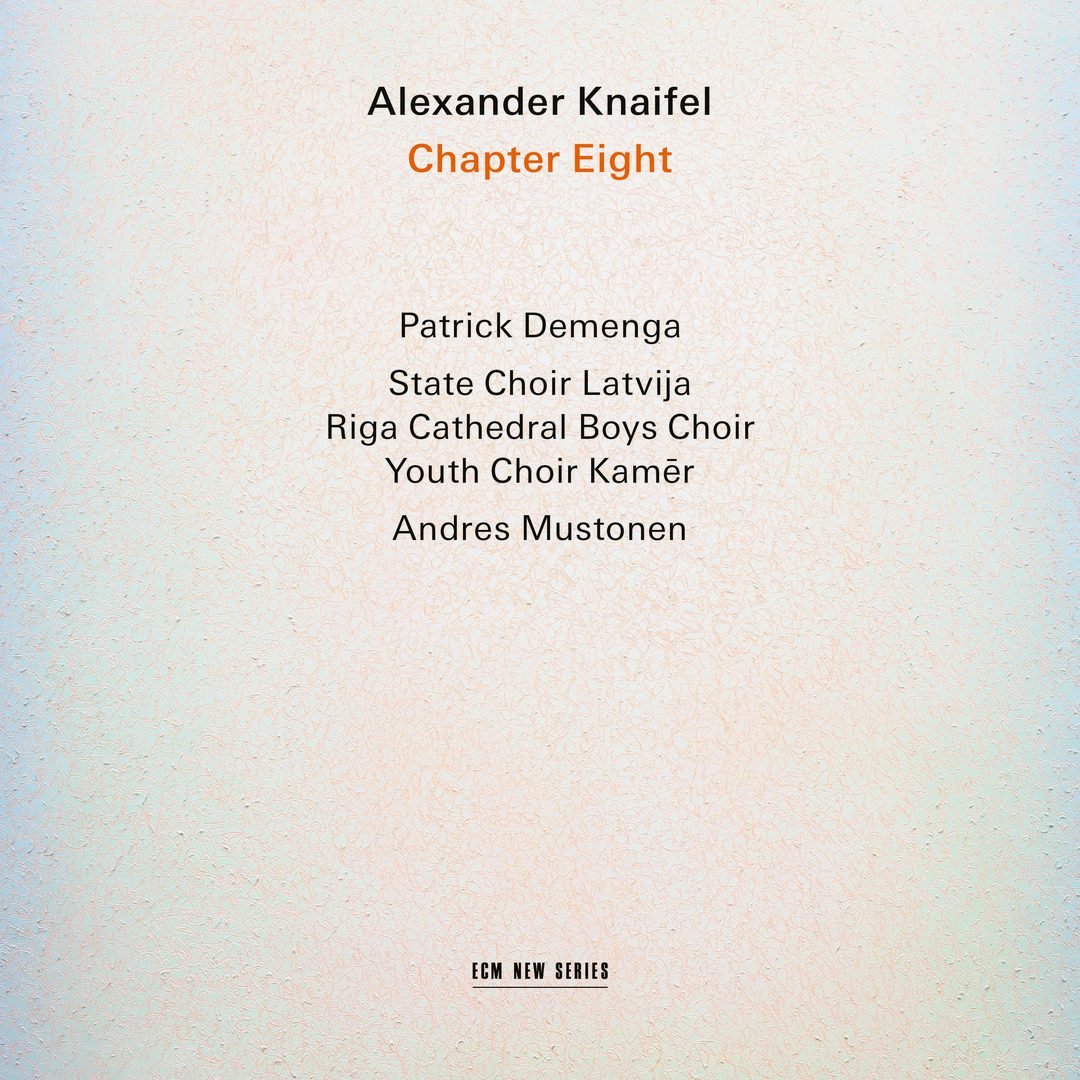
Alexander Knaifel, Patrick Demenga, The State Choir Latvija, Riga Cathedral Boys Choir, Youth Choir Kamēr, Andres Mustonen
Chapter Eight
FormatCDLabelECM New SeriesGenreComposition
Arriving from the supplier (ships as soon as it reaches us)
Tracked express shipping from Italy, no customs or import VAT in the EU. Shipping costs
Chapter Eight is Alexander Knaifel's setting of the last chapter of the biblical Song of Songs, written in 1992 and 1993 for cathedral, choirs and cello. Knaifel (1943-2024) called it a "community prayer" to be realised "in the most reverberant church acoustics", a music "without plot or drama". This concert recording from 2009, with cellist Patrick Demenga, three Latvian choirs and conductor Andres Mustonen, appeared only in 2025, the year after the composer's death.
The work had its premiere at Washington's National Cathedral in 1995, with Mstislav Rostropovich as cellist. He said of it: "It is amazing with what a deep sense of beauty this composition for church, choruses and cello is imbued." Knaifel, born in Tashkent, had studied cello with him at the Moscow Conservatory. The present performance took place in March 2009 at the Jesuitenkirche in Lucerne, a Baroque church known for its acoustics, within the Lucerne Festival. The State Choir Latvija, the Riga Cathedral Boys Choir and the Youth Choir Kamēr were placed in a cross formation in the nave. It is a co-production with Radio SRF 2 Kultur, with Charles Suter as Tonmeister.
The music unfolds in 32 continuous stanzas, here divided into three long tracks of about sixteen, thirty-one and twenty minutes. The fourteen verses of the chapter, sung in Russian, are reordered, condensed and repeated rather than set in sequence. Tempi are extremely slow and dynamics mostly hushed, and the density of the choral sound shifts gradually between the three groups. Demenga does not act as soloist: his line, at times in harmonics, moves within the choral texture and the resonance of the building. Rublev's fifteenth-century icon of the Trinity, which inspired the piece, is reproduced on the back page.
In Gramophone (2025), Richard Whitehouse praised an acoustic "wholly appropriate to the music" and regretted that "it took 16 years for release", noting that Knaifel attended the performance. James Manheim on AllMusic heard music that "is not static but does move, just quite slowly". Earlier ECM recordings of Knaifel include Lux Aeterna (1998), with Patrick and Thomas Demenga, and Blazhenstva.
This is the CD edition, ECM New Series 2637, released on 14 March 2025.
Release notes
Canticum Canticorum for cathedral, choirs and cello Concert recording, March 2009 Jesuitenkirche Luzern Co-production ECM Records/ Radio SRF 2 Kultur Publisher: Compozitor Publishing House, Saint-Petersburg Back page: Andrey Rublyov, The Trinity (early 15th century) This icon inspired the creation of Chapter Eight. [on O-card back; in booklet; on tray card] ℗ 2025 SRF Schweizer Radio und Fernsehen under exclusive license to ECM Records GmbH © 2025 ECM Records GmbH [on disc] ℗ 2025 ECM…
| Canticum Canticorum | |||
| 1 | Stanza I–VII | 15:51 | |
| 2 | Stanza VIII–XXII | 30:51 | |
| 3 | Stanza XXIII–XXXII | 20:10 | |
- Riga Cathedral Boys Choir
- Choir
- The State Choir Latvija
- Choir
- Youth Choir Kamēr
- Choir
- Alexander Knaifel
- Composed By
- Andres Mustonen
- Conductor
- Eberhard Ross
- Cover
- Sascha Kleis
- Design
- Ruedi Wild
- Engineer [Assistant Engineer]
- Urs Dürr
- Engineer [Assistant Engineer]
- Charles Suter
- Engineer [Tonmeister]
- Rolf Grolimund
- Executive-Producer [Executive Producer (SRF)]
- Andrey Rublyov
- Painting
- Anna Knaifel
- Photography By [Liner Photos]
- Patrick Demenga
- Violoncello