Andrew Wasylyk
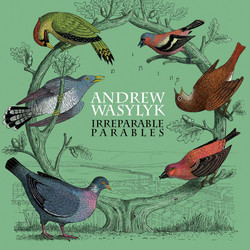
Irreparable Parables (LP, Pink)
Tip! With Irreparable Parables, Andrew Wasylyk reimagines his own practice from the inside out. Long cherished for wordless, liminal records that sit somewhere between chamber jazz, ambient drift and half‑remembered film scores, the Dundee multi‑instrumentalist felt an insistent pull this time toward something that had been largely absent from his work: the human voice. Just as strong was his conviction that he didn’t want that voice to be his own. The result is a rare kind of “solo” album - composed, arranged and produced by Wasylyk, yet carried into the air by a small constellation of guest singers, each invited to write their own lyrics and inhabit the songs from the inside.
The process was as dispersed as the feelings it seeks to hold together. Wasylyk wrote and recorded the music in his Dundee room, surrounded by “half‑broken” instruments: the slightly detuned piano, the wheezing Mellotron, the guitar with its sympathetic rattle. From there, he sent pieces outwards - to Glasgow and Cardiff, to Japan and beyond - asking trusted voices to respond in their own time. Vocals arrived back as files, “like migrating birds,” each part shaped in another room, another life. Out of this gentle correspondence emerged a record that, more than any of his previous work, foregrounds vulnerability and resilience as two sides of the same human coin: people singing into the distance, and a composer patiently braiding those lines into a single, shimmering fabric.
Six singers appear here, each represented on the sleeve by a songbird illustration from Clay Pipe Music’s Frances Castle: a quiet acknowledgement that these are distinct creatures sharing the same canopy. The first we meet is Stuart Murdoch of Belle and Sebastian, whose voice opens “Private Symphony #2” with that familiar, close‑mic intimacy. His lyric curls around Wasylyk’s arrangement with an effortless melodic logic that feels both inevitable and surprising, the kind of contribution that made Andrew feel he’d received “everything I was looking for and more.” Gruff Rhys, Saya Ueno of Tenniscoats and Peter Brewis of Field Music bring their own sensibilities - oblique wit, fragile wonder, clear‑eyed craft - writing words that sit so naturally on Wasylyk’s music it can be hard to believe the pieces didn’t grow in the same room.
Instrumentally, Irreparable Parables expands the palette we’ve come to associate with Wasylyk while remaining recognisably his. Brass and woodwind sigh and flare at the margins; a six‑piece string section, arranged by long‑time collaborator Pete Harvey, threads in and out of the songs like shifting weather; guitar, bass and drums move with understated assurance; vibraphone, Mellotron, Fender Rhodes, tape loops and synths add that unmistakable Wasylyk glow, where analogue warmth and a faint patina of tape hiss make each chord feel worn‑in, lived‑with. The overall sound world sits just beyond genre borders: not quite classical, not quite jazz, not quite ambient, yet borrowing the emotional directness of all three. The music is difficult to summarise, but remarkably easy to feel. It lands as mood first, information second - like catching a particular light on a familiar street and being momentarily overcome by a memory you can’t quite name.
At the record’s heart lie two songs that seem to crystallise its themes. “Love Is A Life That Lasts Forever,” sung by Molly Linen and brightened by trumpets, takes its cue from the writings of Derek Jarman. Born from a period in which Wasylyk felt “deeply upset about the world,” it reaches stubbornly toward hope, holding onto the idea of love as something that can outlast the immediate wreckage. In contrast, “Spectators In The Absence of God,” written and sung by Kathryn Joseph, functions as an “apocalyptic hymn.” Over an arrangement that feels both hushed and tectonic, Joseph grapples with the experience of watching suffering from a distance - safe in physical terms, yet psychologically wounded by relentless awareness, haunted by complicity and helplessness. Her cracked tenderness, the way her voice seems to fray at the edges of certain lines, makes the song feel less like commentary and more like a shared confession.
Wasylyk himself finally steps to the microphone on the title track. A throat infection and subtle pitch‑shifting have altered his voice just enough to bypass his longstanding discomfort with hearing himself sing, rendering him slightly other to himself, yet unmistakably present. It’s a small, telling detail: even as he gives the album over to other voices, he allows his own, imperfect and processed, to sit among them as another fragile instrument. The record closes with the instrumental “Soul Enters The Ocean Sun Climbs Out Of The Sea,” an all‑piano‑and‑strings coda that offers a sense of calm ascent - not a neat resolution, but a gentle widening of perspective, like stepping back from a stained‑glass window and finally seeing the whole.