Eleni Karaindrou
Trojan Women - Music for the Stageplay by Euripides
FormatCDLabelECM New SeriesGenreComposition
Arriving from the supplier (ships as soon as it reaches us)
Tracked express shipping from Italy, no customs or import VAT in the EU. Shipping costs
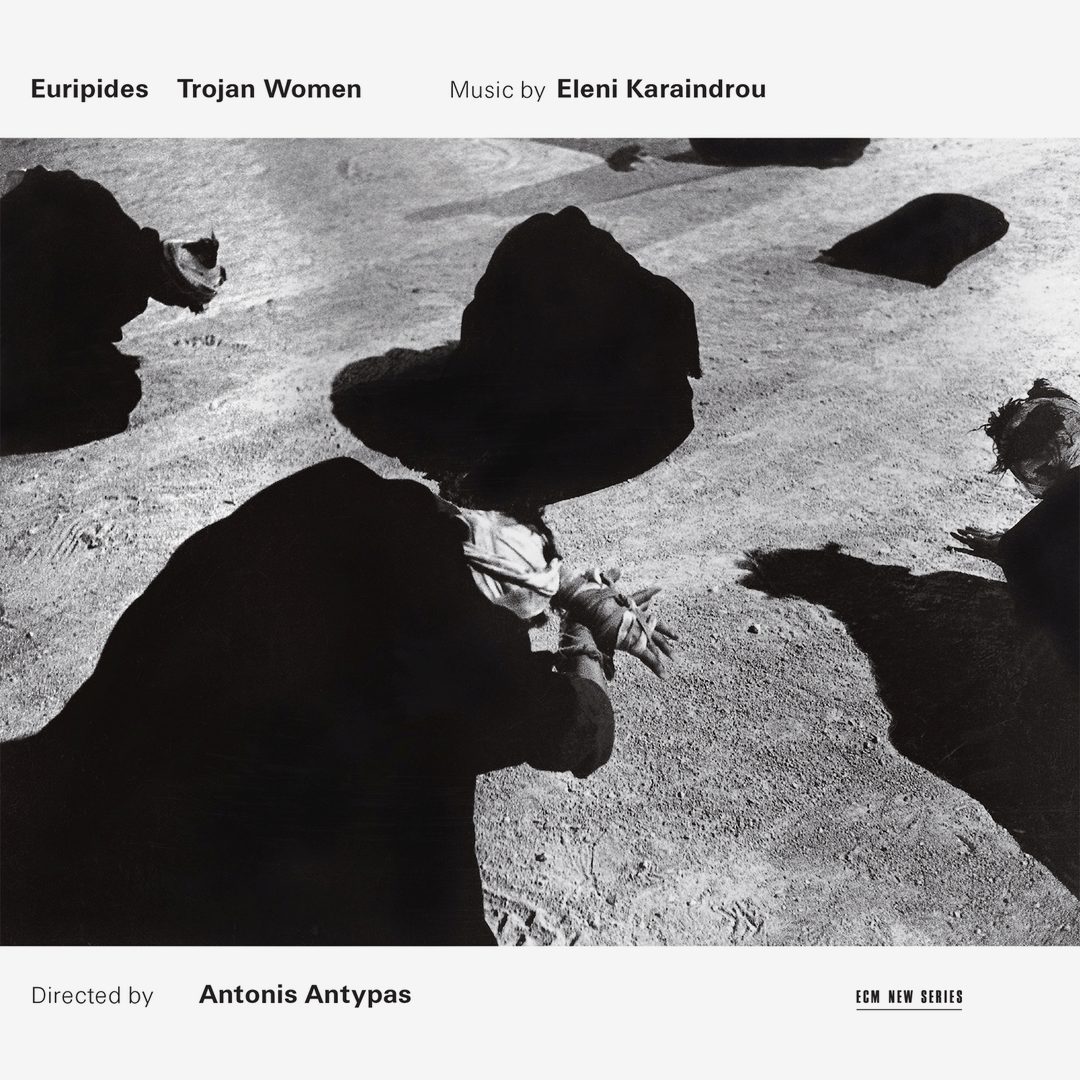
Trojan Women collects the music that the Greek composer Eleni Karaindrou wrote for a new staging of Euripides' tragedy, first given at the Ancient Theatre of Epidaurus in 2001. After four ECM albums drawn from her film scores, this was her first record of music for the theatre. Its sound is unlike those orchestral works: a chorus of women's voices and a small group of traditional instruments carry thirty short pieces of lament, ode and procession.
The production was directed by Antonis Antypas, using a modern Greek version of the text by K. X. Myris. It opened at the Hellenic Festival on 31 August 2001 and then toured Greece and Cyprus. The music had been recorded the month before, in July 2001, at Studio Polysound in Athens, with Manfred Eicher producing. The chorus of captive Trojan women was prepared and directed by Antonis Kontogeorgiou, with soprano Veronika Iliopoulou among the soloists. Sokratis Sinopoulos plays Constantinople lyra and laouto, with ney, oud, kanonaki, santouri, harp and percussion around him.
Apart from the harp, there are no Western orchestral instruments. The lyra carries much of the melodic line, and the short instrumental themes for Hecuba, Cassandra, Andromache and the child Astyanax return across the sequence like recurring faces. The choral odes are the backbone of the work. In the First Stasimon, An Ode of Tears, the voices move in slow, plain lines, and the Third Stasimon, In Vain the Sacrifices, answers it with greater force. Terra Deserta is a bare instrumental landscape where the harp's resonance fills the empty space.
Euripides wrote the play in 415 BC, after the Athenian destruction of Melos, and it remains one of the great anti-war texts of the stage. Writing in The Observer, Tarik O'Regan found the sounds of instruments and chorus "unique and deeply meditative in their mystical resonance." In the French magazine Classica, Bertrand Dermoncourt heard the choruses punctuate the action "with an austerity" he found fascinating, and summed up: "Simple and touching: profoundly human." Karaindrou and Antypas later worked together again on Euripides' Medea, released by ECM in 2014.
This is the CD edition of ECM New Series 1810, first released in 2002.
Release notes
Music for Trojan Women by Euripides Production: Aplo Theatro / Fasma Artistic Organisation World Premiere Hellenic Festival, August 31, 2001 Ancient Theatre of Epidaurus Recorded July 2001 Studio Polysound, Athens An ECM Production ℗ 2002 ECM Records GmbH © 2002 ECM Records GmbH O-card package with standard jewel case; O-card booklet with 40 pages, jewel case booklet with 16 pages
| 1 | Voices | 2:08 | |
| 2 | Lament I | 1:17 | |
| 3 | Desolate Land I | 1:05 | |
| 4 | Lament II | 1:05 | |
| 5 | Hecuba’s Lament | 1:23 | |
| 6 | Parodos: The Land I Call Home | 2:18 | |
| 7 | Parodos: Home Of My Forefathers | 1:50 | |
| 8 | Parodos: I Wish I'm Given There | 1:35 | |
| 9 | Cassandra’s Theme | 2:02 | |
| 10 | Cassandra’s Trance | 2:52 | |
| 11 | First Stasimon: An Ode Of Tears | 4:03 | |
| 12 | First Stasimon: For The Phrygian Land A Vast Mourning | 2:00 | |
| 13 | Andromache’s Theme | 1:07 | |
| 14 | Andromache’s Lament | 1:06 | |
| 15 | Terra Deserta | 2:16 | |
| 16 | Astyanax’ Theme | 0:59 | |
| 17 | Hecuba’s Theme I | 0:42 | |
| 18 | Hecuba’s Theme II | 0:38 | |
| 19 | Second Stasimon: Telamon, You Came To Conquer Our Town | 1:51 | |
| 20 | Second Stasimon: The City That Gave Birth To You Was Consumed By Fire | 1:17 | |
| 21 | An Ode Of Tears | 0:59 | |
| 22 | Desolate Land II | 1:07 | |
| 23 | Lament III | 0:42 | |
| 24 | Third Stasimon: In Vain The Sacrifices | 2:03 | |
| 25 | Third Stasimon. My Beloved, Your Soul Is Wandering | 3:09 | |
| 26 | Hecuba’s Theme | 1:18 | |
| 27 | Lament For Astyanax: Oh Bitter Lament, My Bitter Boy | 1:52 | |
| 28 | Exodos | 2:25 | |
| 29 | Exodos: Accursed Town | 1:02 | |
| 30 | Astyanax’ Memory | 1:01 |
- K. X. Myris
- Adapted By (Text) [Modern Greek Adaptation]
- Andreas Papas
- Bendir, Percussion [Daouli]
- Sophia Spyratou
- Choreography [Movement]
- Alexandra Delitheou
- Chorus
- Anna Mouzaki
- Chorus
- Chorus Of Captive Trojan Women
- Chorus
- Dora Tzerounian
- Chorus
- Ekaterina Pavlaki
- Chorus
- Emilia Valvi
- Chorus
- Eva Karyati
- Chorus
- Katerina Lypiridou
- Chorus
- Melina Vamvaka
- Chorus [Leader Woman A]
- Aliki Avdelopoulou
- Chorus [Leader Woman]
- Mara Koukoula
- Chorus [Leader Woman]
- Maria Syrianou
- Chorus [Leader Woman]
- Maria Tsima
- Chorus [Leader Woman]
- Penelope Markopoulou
- Chorus [Leader Woman]
- Stella Rapti
- Chorus [Leader Woman]
- Veronika Iliopoulou
- Chorus [Leader Woman], Soprano Vocals
- Yanna Nikolopoulou
- Chorus [Leader Woman]
- Sascha Kleis
- Design
- Antonis Kontogeorgiou
- Directed By [Chorus Director], Musical Assistance [Musical Training For Voices]
- Antonis Antypas
- Directed By [Stage Director]
- Manfred Eicher
- Edited By [Editing], Mastered By [Mastering], Producer [Produced By]
- Yiannis Ioanidis
- Edited By [Editing], Mastered By [Mastering]
- Yiorgos Karyotis
- Engineer [Recording Engineer]
- Maria Bildea
- Harp
- Panos Dimitrakopoulos
- Kanun [Kanonaki]
- Andreas Sinanos
- Lighting
- Eleni Karaindrou
- Liner Notes, Music By, Recording Supervisor [Recording Supervision]
- Socratis Sinopoulos
- Lyre [Constantinople Lyre], Lute [Laouto]
- Christos Tsiamoulis
- Ney, Suling, Oud [Outi]
- Kostas Ordolis
- Photography By [Cover Photo]
- Athina Kazolea
- Photography By [Liner Photos]
- Andreas Katsiyiannis
- Santoor [Santouri]
- Giorgos Patsas
- Set Designer [Set], Other [Costumes]
- Harina Deliyannis-Easty
- Translated By