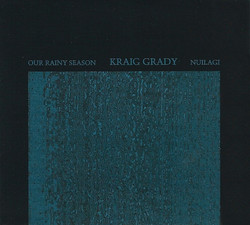
Kraig Grady, an American based in Australia, is a microtonal composer. He explains it thus: “Alternative tunings are a major inspiration for my compositional explorations. The pivotal point for me was meeting with tuning theorist Ervin Wilson and witnessing Harry Partch’s U.S. Highball in 1975. I was convinced that working with different instruments and tunings was going to be a major artistic movement.
I began studying tuning with Wilson which continued for as long as we knew each other. … I’m interested in using acoustic instruments as sound sources to explore new acoustic phenomena that cannot be mistaken for electronic manipulation.”
The starting point for the works on this CD was to record each performer playing individual notes in the given microtonal tuning with extreme pitch accuracy. The recordings are edited to capture the personal expressivity of the players and the individuality of their gestures in the recordings become inseparable from the composition process. These recordings of individual notes are then weaved together to form melodic lines and combined to build harmonies and shifting textures.
Liner notes by Grady with illustrated samples.
Kraig Grady is an Australian-American composer, born in Montebello, California in 1952. He studied with Nicolas Slonimsky, Dean Drummond, Dorrance Stalvey and Byong-Kon Kim. Since meeting tuning theorist Ervin Wilson in 1975, he has worked in alternative tunings based on Wilson’s theories. He has composed and performed with an ensemble of his own exclusively acoustic microtonal instruments tuned to just intonation scales.
He has also worked as a shadow puppeteer, tuning theorist, filmmaker, world music radio DJ, and concert promoter as the president of the Independent Composers Association in Los Angeles.
Since moving to Australia in 2007, he has presented his works at Liquid Architecture, NOW now Festival and Aurora Festival. He collaborated with Ensemble Offspring in a performance at the Sydney Opera House which featured his Centaur scale as the chosen tuning of the project. He is the co-founder and presenter of Sydney MicroFest, an annual festival of Australian microtonal music.
1. The Molten Wind (19:59)
2. Crow on the Dark Side of Gloss (28:03)
The Molten Wind: Stephen Adams, voice; Michael Dixon, French horn; James Eccles, viola; Kraig Grady, hammered dulcimer; Lamorna Nightingale, flute, bass flute
Crow on the Dark Side of Gloss: Michael Dixon, French horn; Aviva Endean, clarinet; Anna Linardou, voice; Rufus Olivier Jr, bassoon; Melinda Rice, violin, viola; Giorgos Varoutas, pedal steel guitar