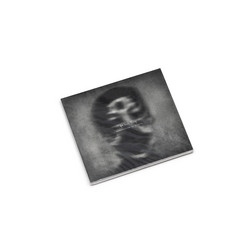
*150 copies limited edition* The ambient lineage, from Brian Eno’s Music for Airports forward, has been characterized as sounds that can recede into the background, creating an absence that exists laterally to the listener’s attention. The Kinetic Void originated from a different premise. The compositions assembled here retain a commitment to atmosphere, putting texture over melody and suspending conventional notions of meter. But they embody an inverted relationship to density from that of the tradition. These pieces are present, saturating and confronting the listener with detail, weight, and structural complexity, yet stopping short of being pure noise.
There is no settled name for this particular style of music. It has no genre, though it can be described in terms of adjacencies: the more abrasive moments of Ben Frost, the looping decay of William Basinski, the layered distortion of some Tim Hecker pieces. When I put together the call for submissions for what became The Kinetic Void, I felt as if I was throwing a dart while blindfolded, hoping that I hit a target that I could not fully articulate. It was a leap of faith that the artists who answered the call would understand what I intended – that the void of the title was not a space to be preserved but a vacancy to be intentionally overloaded by the compositional act. I was not disappointed. The ten tracks of this album take these notions in different and even surprising directions. The densities of these pieces vary along compositional, textural, and emotional axes. Some artists, such as Nihil Impvlse and Soloi Sounds, develop intricate, overlapping strata. Others explore the capacity of a single instrument, as in the guitar work of Gianluca Becuzzi and Robert Thurman.
Richard Bégin presents a work based around a three-note pattern that builds to a crescendo before falling back into quietude. Browning Mummery explores patterns of percussion in combination with feedback and swirling noise. Rumore and William St. Hugh’s contributions are two sides of the same coin, the former focused on sculpted distortion, the latter on a haunting soundscape that uses tension to fill space. Similarly, Mario Lino Stancati employs echoes and processing as load bearing elements. Autistici closes the album with dissonant fragments drawn from instruments, field recordings, and synthetic sources. I am grateful to these artists who answered the call. What began as a question about how silence might be populated has become, across these ten pieces, a set of answers. The void has been filled for now, and in ways that I had not considered.







![Σ [sigma]](https://cdn.soundohm.com/data/products/2026-10/a0550686140_10-jpg.jpg.250.jpg)