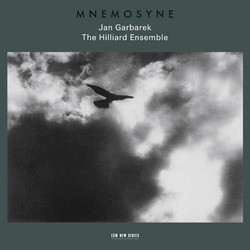
Officium Novum is the third album by Jan Garbarek and The Hilliard Ensemble, a partnership that began with Officium in 1994. On that record the Norwegian saxophonist first let his improvised lines move freely around four voices trained in early music. Mnemosyne followed in 1999 and widened the repertoire to music both ancient and modern. This third chapter turns east. At its centre are Armenian sacred songs in the arrangements of Komitas Vardapet, drawing on medieval chant and on the bardic tradition of the Caucasus. Around them stand Byzantine and Russian Orthodox chant, Pérotin, Arvo Pärt and two songs by Garbarek himself.
Like its predecessors, the album was made at the Propstei St. Gerold, the Austrian monastery whose long, soft acoustic has become part of the project's sound. It was recorded in summer 2009 with Manfred Eicher producing and Peter Laenger as engineer. Garbarek plays soprano and tenor saxophones, and the arrangements are credited jointly to him and the four singers, who had studied the Armenian pieces during their visits to the country. The actor Bruno Ganz appears for a few seconds at the very end. The booklet carries photographs by Mario Giacomelli and an essay by Thomas Steinfeld.
Four of the twelve tracks come from Komitas, and they give the album its character. Surb, surb, the Sanctus of the Armenian liturgy, has a saxophone line that starts close to the sound of a duduk and drifts away from it as the improvisation grows. The thirteen-minute Litany joins a litany with the Slavonic Otche nash and Dostoino est, leaving room for sung and played solos alike. Pärt's Most Holy Mother of God is sung a cappella. A new version of Garbarek's We are the stars then leads to a short German reading by Ganz of lines by the Greek poet George Seferis.
Nenad Georgievski wrote in All About Jazz that the musicians “have saved something very deep and enchanting from oblivion.” For Barry Witherden in BBC Music Magazine, “over the immanent, limpid voices Garbarek improvises equally immaculate counter-melodies.” He also noted that the formula had not developed much. Writing in Songlines, Simon Broughton described the Armenian material as the core of the record and the saxophone as a fifth voice in the group.
CD, ECM New Series 2125, first released on 17 September 2010, with a booklet of notes and photographs.