Keith Jarrett
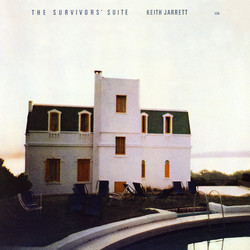
The Survivors' Suite
CD version. The Survivors' Suite is the high point of the "American Quartet" that Keith Jarrett led with Dewey Redman, Charlie Haden and Paul Motian. It is also one of the most enduring records in the ECM catalogue. Recorded in April 1976 and issued in 1977, it is a single composition of almost fifty minutes, divided between Beginning and Conclusion. Across both parts the band works as one body rather than as soloists with accompaniment.
The quartet had been recording for Impulse! since the early 1970s, while in Europe Jarrett also led a second group with Jan Garbarek. For this session the four musicians went to Tonstudio Bauer in Ludwigsburg, with Martin Wieland as engineer and Manfred Eicher producing. Jarrett plays piano, soprano saxophone, bass recorder, celeste and osi drums, Redman tenor saxophone and percussion, Haden double bass, and Motian drums and percussion. Jarrett also took the cover photograph. In a 2009 interview with Stuart Nicholson he said the music was written for a concert at Avery Fisher Hall in New York. The stage sound there made fast tempos impractical, so the suite has none. A month later, in May 1976, the same quartet was recorded live in Bregenz for Eyes of the Heart, its last album.
Beginning opens slowly, with the dark tone of the bass recorder over Haden's plucked bass, and settles into a repeated figure before the two saxophones state the main theme. Later Jarrett moves to the piano and the theme returns in full, while Motian colours the time rather than marking it. Conclusion starts in turbulence, with Redman's tenor at its most raw. It moves through long improvised stretches towards a climax that opens out into a broad, singing melody.
Melody Maker called it "a brilliantly organized and full-blooded work which provides the perfect setting for all four talents". The Wire heard a composition that "seems to redefine 'intensity' each time it turns a corner", and singled out Redman over the surging rhythms of the second side.
This is the CD edition of ECM 1085 (catalogue 827 131-2), first released in 1977.