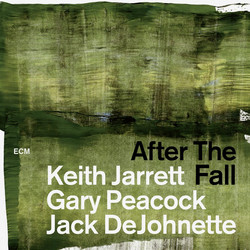
Always Let Me Go catches the trio of Keith Jarrett, Gary Peacock and Jack DeJohnette in its twentieth year, playing without a single standard. Jarrett described it as "free music that was not written, rehearsed or planned in advance of the performances", and called it the group's most concentrated work to date. Recorded at two concerts in Tokyo, the double album gives the long improvisations room to run their full course.
The music was taped in April 2001 at Orchard Hall and the Bunka Kaikan in Tokyo, with Jarrett on piano, Peacock on double bass and DeJohnette on drums. Yoshihiro Suzuki engineered the recording, and Jarrett produced it with Manfred Eicher. It followed Inside Out, recorded in London in July 2000, which first took the so-called Standards Trio back to open improvisation. The title plays on Never Let Me Go, a standard the trio had recorded earlier. Six pieces are credited to Jarrett and two, Tributaries and Facing East, to all three players.
The scale is unusual. Hearts In Space opens the first disc at thirty-two minutes. It moves from scattered gestures towards a shared circular figure, which Peacock takes over and alters, and later finds a ballad when DeJohnette pushes to the front. Waves fills more than thirty-four minutes of the second disc. Between them sits The River, a brief and quiet passage for solo piano. ECM's notes hear allusions to the whole history of jazz, and references running from Thelonious Monk to Anton Webern, with deep grooves set against silences and quiet dissonance. Jarrett still carries many of the melodic leads, but the centre of attention moves constantly between the three.
In DownBeat in December 2002, Thomas Conrad gave it five stars and called it "one of Jarrett's major achievements on record". In The Observer, Dave Gelly found it hard to believe "that three minds can be quite so minutely attuned to one another". Jazzwise heard the trio's concept of improvisation advanced a step further than on Inside Out.
This is the double CD on ECM Records, ECM 1800/01, first released in October 2002, with a booklet containing Jarrett's essay The Visionary.