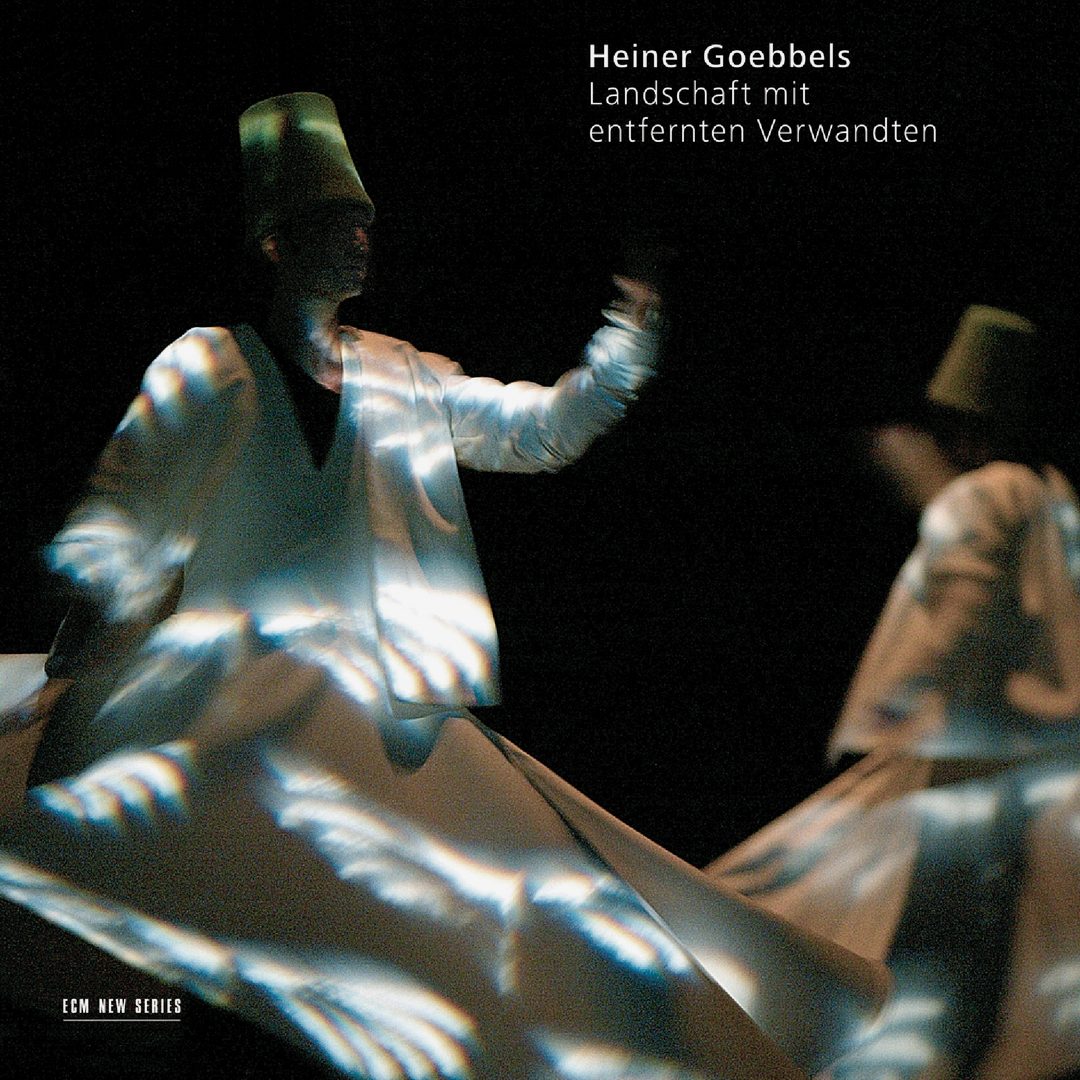
Heiner Goebbels, David Bennent, Georg Nigl, Ensemble Modern, Deutscher Kammerchor, Franck Ollu
Landschaft mit Entfernten Verwandten
FormatCDLabelECM New SeriesGenreComposition
Arriving from the supplier (ships as soon as it reaches us)
Tracked express shipping from Italy, no customs or import VAT in the EU. Shipping costs
Landschaft mit entfernten Verwandten (Landscape with Distant Relatives) is the first stage work that Heiner Goebbels called an opera, and this CD is its recorded counterpart. Commissioned by the Grand Théâtre de Genève and premiered in Geneva in October 2002, it has no linear plot. Instead it assembles texts from several centuries around war, history and the uneasy relation between art and reality. Goebbels sets them in a music that moves freely from Renaissance pastiche to Bollywood and country.
The recording was made live in October 2004 at the Théâtre des Amandiers in Nanterre, during the Festival d'Automne in Paris, as a co-production of ECM, Ensemble Modern and SWR Baden-Baden. Franck Ollu conducts the Ensemble Modern and the Deutscher Kammerchor, whose sixteen singers also take solo lines. The baritone Georg Nigl and the actor David Bennent share the leading roles as equals, one singing and one speaking. Max Federhofer was the Tonmeister and mixed the album with the composer, and Manfred Eicher was executive producer.
The texts come from Gertrude Stein, Giordano Bruno, Henri Michaux, T. S. Eliot, Leonardo da Vinci and Nicolas Poussin. The work falls into two parts that begin with the same introduction, the second time with speech added. Three large pieces anchor the first part: Tanz der Derwische, Eliot's Triumphal March with its obsessive lists and figures, and Schlachtenbeschreibung. In this setting of Leonardo's description of a battle, Nigl sings over an agitated ensemble. The second part turns to cities, journeys and radio. It takes in a Hindi film song by A. R. Rahman and the cowboy song Out Where the West Begins, and ends with Poussin's Principes as a slow drone.
In The Guardian in December 2007, Andrew Clements noted that the disc cannot carry the visual side of the staging, but found it "totally absorbing" even as a soundtrack. Le Monde de la musique gave the album its Choc du mois. Rob Cowan, in The Independent, described a score that runs from early instruments to "teeth-baring aggression", including "an army of drummers raising merry hell." The players of the Ensemble Modern switch between a wide array of instruments, from harpsichord, musette and Chinese bamboo flute to sampler and bass guitar.
This is the CD edition of ECM New Series 1811, first released in 2007.
Release notes
Opera for soloists, choir and ensemble with texts by Gertrude Stein, Giordano Bruno, Henri Michaux, T. S. Eliot, Leonardo da Vinci and Nicolas Poussin Co-production ECM Records, Ensemble Modern, SWR Baden-Baden Recorded live October 2004 Théâtre des Amandiers, Nanterre, Paris ℗ 2007 ECM Records GmbH © 2007 ECM Records GmbH Printed in Germany
| Part One | |||
| 1 | Il Y A Des Jours | 1:52 | |
| 2 | Non Sta | 0:48 | |
| 3 | The Sirens | 2:17 | |
| 4 | Ove È Dunque | 2:46 | |
| 5 | Les Inachevés | 1:05 | |
| 6 | Tanz Der Derwische / Emplie De | 8:25 | |
| 7 | In The 19th Century | 2:50 | |
| 8 | Triumphal March | 5:42 | |
| 9 | Homme-Bombe | 2:06 | |
| 10 | Schlachtenbeschreibung | 9:01 | |
| 11 | Well Anyway | 1:54 | |
| 12 | Did It Really Happen? | 2:16 | |
| 13 | Kehna Hi Kya | 3:16 | |
| 14 | Et C’est Toujours | 2:52 | |
| Part Two | |||
| 15 | Il Y A Des Jours | 3:09 | |
| 16 | La Fronde À Hommes | 2:22 | |
| 17 | Just Like That | 1:52 | |
| 18 | Bild Der Städte | 1:30 | |
| 19 | Ich Leugne Nicht Die Unterscheidung | 2:52 | |
| 20 | Krieg Der Städte | 1:41 | |
| 21 | On The Road | 2:42 | |
| 22 | And We Said Good Bye | 0:38 | |
| 23 | On The Radio | 1:54 | |
| 24 | Different Nations | 2:05 | |
| 25 | Out Where The West Begins / Train Travelling | 2:26 | |
| 26 | Je Ne Voyage Plus / Freight Train | 4:36 | |
| 27 | Principes | 4:41 | |
- Annette Kohler-Welge
- Alto Vocals
- Paul Gerhardt Adam
- Alto Vocals
- Georg Nigl
- Baritone Vocals
- Ekkehard Abele
- Bass Vocals
- Michael Albert
- Bass Vocals
- Barbara Kehrig
- Bassoon, Voice
- Michael M. Kasper
- Cello, Cello [Table Cello]
- Eva Böcker
- Cello, Voice
- Deutscher Kammerchor
- Choir
- Roland Diry
- Clarinet [Clarinets]
- Wolfgang Stryi
- Clarinet, Bass Clarinet, Alto Saxophone
- Heiner Goebbels
- Composed By, Mixed By, Music By (1 to 12, 14 to 24, 26, 27)
- Franck Ollu
- Conductor
- Sascha Kleis
- Design
- Hans-Joachim Tinnefeld
- Double Bass, Bass Guitar
- Max Federhofer
- Engineer [Tonmeister], Mixed By
- Ensemble Modern
- Ensemble
- Manfred Eicher
- Executive-Producer
- Dietmar Wiesner
- Flute, Alto Flute, Flute [Chinese Bamboo Flute]
- Ueli Wiget
- Harpsichord, Piano, Harp
- Arthur Chapman
- Lyrics By (25)
- Gertrude Stein
- Lyrics By (3, 7, 11, 12, 17, 21, 23 to 25)
- Giordano Bruno
- Lyrics By (2, 4, 19)
- Henri Michaux
- Lyrics By (6, 9, 14 to 16, 26)
- Leonardo da Vinci
- Lyrics By (10)
- Mehboob
- Lyrics By (13)
- Nicolas Poussin
- Lyrics By
- T. S. Eliot
- Lyrics By (8)
- Traditional
- Lyrics By (26)
- Allah Rakha Rahman
- Music By (13)
- Estelle Philleo
- Music By (25)
- Catherine Milliken
- Oboe, Musette, Voice
- Rainer Römer
- Percussion [Ngara], Daf, Guitar [Table Guitar], Drums
- Wonge Bergmann
- Photography By
- Hermann Kretzschmar
- Piano, Sampler, Accordion
- Cornelia Winter
- Soprano Vocals
- Gundula Anders
- Soprano Vocals
- Bernhard Scheffel
- Tenor Vocals
- Friedemann Büttner
- Tenor Vocals
- Uwe Dierksen
- Trombone
- Sava Stoianov
- Trumpet, Piccolo Trumpet
- Valentin Garvie
- Trumpet, Trombone
- Rumi Ogawa
- Vibraphone, Percussion
- Susan Knight
- Viola, Voice
- Jagdish Mistry
- Violin, Voice
- Swantje Tessmann
- Violin, Voice
- David Bennent
- Voice