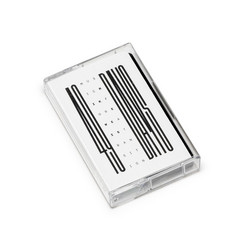
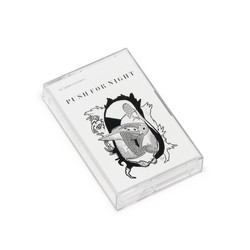
That Porous Line is the sound of Push For Night learning to live inside the in‑between. Rather than treating genres as borders to be defended, the album lingers where they overlap - in the hazy space where guitars behave like synths, rhythms feel more like breathing than beats, and vocals drift somewhere between lyric, echo and texture. The title is a quiet manifesto: every track worries at that membrane between inside and outside, clarity and blur, foreground and background, until the distinctions start to fray.
From the outset, the record moves with a kind of patient urgency. Songs grow out of minimal gestures - a repeating guitar figure, a muffled drum pattern, a grainy pad - that slowly accrete detail. Melodies tend to emerge sideways, catching your ear as a phrase that seems to have always been there rather than as a big entrance. The band favour muted colours: overdriven but not macho, saturated but not slick. It’s a palette that lets small changes register as seismic. When a harmony opens up, when a hi‑hat suddenly begins to tick more insistently, when a synth line finally steps forward, it feels like the room itself has shifted.
Central to That Porous Line is its approach to voice. Rather than riding on top of the mix as a clear narrative guide, vocals sit half‑submerged, sometimes intelligible, sometimes falling back into pure sound. Words smear at the edges, doubles and harmonies sliding just out of sync, delay tails turning syllables into soft percussive debris. This keeps the emotional temperature high but the meaning open: you understand the feeling long before you can pin down what’s being said. It’s a tactic that matches the music’s fascination with thresholds - everything is almost fixed, almost defined, and that “almost” is where the charge lives.
The production leans into this sense of permeability. Guitars bleed into drum mics; synths are re‑amped through small amps and allowed to pick up room noise; incidental sounds - fingers on strings, pedal clicks, the scrape of a chair - are left in the frame. Rather than chasing a pristine, sealed image, That Porous Line cultivates a lived‑in grain, the sense that these tracks are documents of real air being moved in real rooms. Mixing blurs strict hierarchies: at times the snare is the loudest thing in the world, at others the entire kit feels like it’s been pushed behind a fog of keys and feedback. These shifts keep the ear on edge, never fully sure what will be foregrounded next.