Charlemagne Palestine
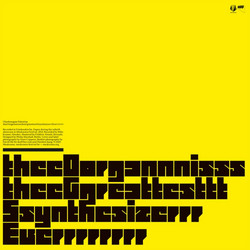
The Organ is the Worlds Greatest Syntesizer (LP)
Tracked express shipping from Italy, no customs or import VAT in the EU. Shipping costs
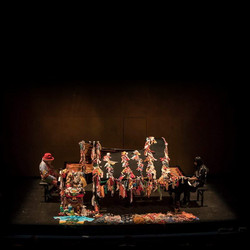
At eight o'clock on a March morning in 2024, as Amsterdam awakened around it, Charlemagne Palestine took his place at the console of the Vater-Müller organ in the Oude Kerk—the city's oldest building, a Gothic monument dating to 1306—and opened a portal. What emerged over the following forty-plus minutes, now captured on this limited edition LP, stands as one of the most concentrated distillations of Palestine's six-decade practice: a living document of resonance, ritual, and the alchemical transformation of architectural space into vibrating organism.
The occasion was the fiftieth anniversary of Silence, the Oude Kerk's legendary morning concert series, presented in collaboration with Sonic Acts on its own thirtieth anniversary Biennial. Palestine—born Chaim Moshe Tzadik in Brooklyn in 1947, trained first as a Jewish cantor and then as carillonneur at St. Thomas Episcopal Church on Fifth Avenue—has spent his entire career exploring what happens when sustained tones accumulate in sacred spaces. The Vater-Müller organ, built in 1724 by Christian Vater and later expanded by Johann Caspar Müller, is regarded as one of the finest Baroque organs in Europe. It sits beneath the largest medieval wooden vault on the continent—the same church where Jan Pieterszoon Sweelinck served as organist for over four decades.
Palestine begins with a resonating bell and his distinctive falsetto overtone singing—the voice trained with Pandit Pran Nath between 1968 and 1972. Then he surrenders to the organ, allowing single tones to evolve into clusters, frequencies to entangle. Beat frequencies pulse and shimmer. Overtones stack upon overtones. The architecture becomes audible. Where his legendary Strumming Music of 1974 pushed the piano toward its breaking point, the organ demands a different kind of intensity: the management of sustained breath, the sculpting of decay, the patience to let acoustical phenomena unfold at their own pace. The organ does not break. It envelops.
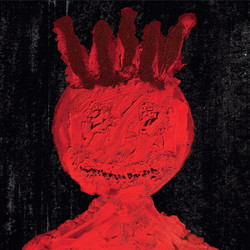
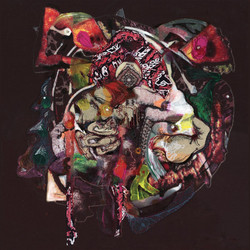
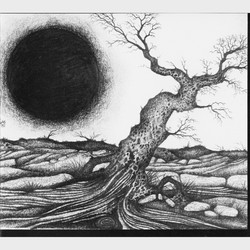
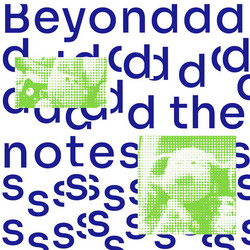
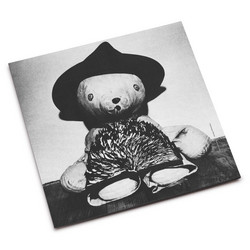
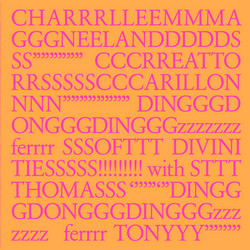
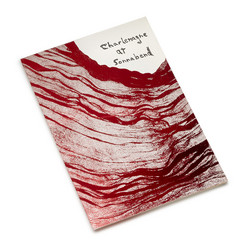
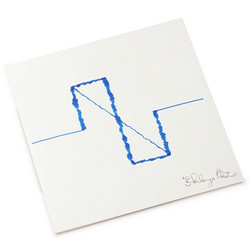
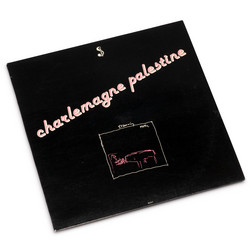
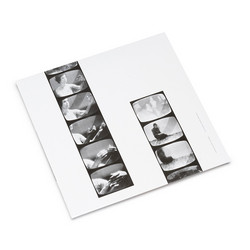
The title—The Organ is the World's Greatest Synthesizer—comes from a drawing Palestine made during the performance, reproduced as the album's cover art. It is characteristic of his maximalist wit, his refusal of the "minimal" label. In Palestine's hands, a three-hundred-year-old instrument reveals itself as the original modular system—stops and ranks as oscillators, the building's stone and wood as resonant filters, the listener's own body as the final transducer.
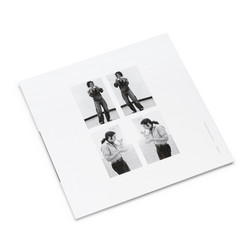
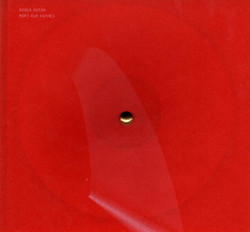
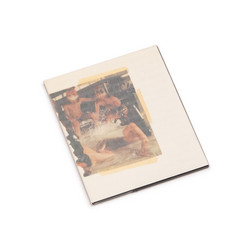
This marks Palestine's return to the Staalplaat catalogue after Fffroggssichorddd (2020) and Music for Big Ears (2001). The LP arrives in a limited edition of 222 copies, hand-sewn in Staalplaat tradition with a two-color screenprinted cover. Recording captured and mastered by Radboud Mens.
In the Oude Kerk, beneath that vast medieval ceiling, within the embrace of the Vater-Müller's Baroque magnificence, Palestine found his instrument one more time. The point, as he has always insisted, is not to learn anything but simply to enter.
This edition
Limited edition of 222 copies, black vinyl two color screenprinted cover
Format
Live at the Oude Kerk, Amsterdam
Recorded during Sonic Acts Biennial 2024, March 1
Silence Concert Series, 50th Edition
Recorded and mastered by Radboud Mens
Cover art: Charlemagne Palestine
With kind permission of Oude Kerk Amsterdam
Limited edition of 222 copies
Black vinyl, two-color screenprinted cover, hand-sewn