Keiji Haino, Reinhold Friedl
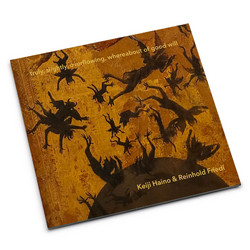
Truly, Slightly, Overflowing, Whereabout of Good Will (LP)
Label: Bocian Records
Format: LP
Genre: Experimental
Out of stock
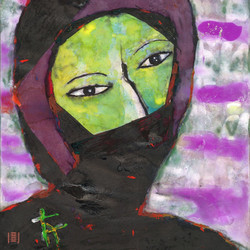
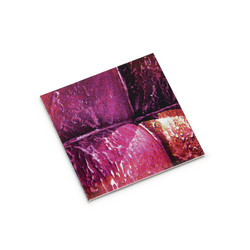
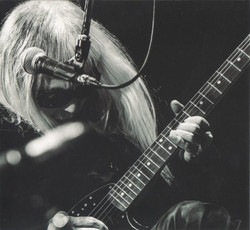
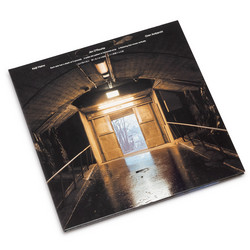
* Limited LP with gold foil print cover * Truly, Slightly, Overflowing, Whereabout of Good Will stages an encounter that feels both inevitable and astonishingly raw: Keiji Haino, the mercurial vocalist and talismanic figure of the Japanese underground, in intimate dialogue with pianist and sonic radical Reinhold Friedl. Rather than meeting in the expected zones of electric guitar overload or full ensemble density, they choose the most exposed configuration possible - voice and piano alone, the latter often played from the inside, strings struck, rubbed and caressed as much as they are conventionally keyed. What emerges is not a collection of “songs” in any familiar sense, but a sequence of charged situations in which timbre, breath and resonance are pushed to their breaking points.
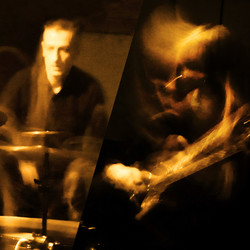
From the opening moments, the album establishes a vocabulary of friction and suspension. Haino’s voice moves between near‑inaudible murmur, prayer‑like chant and full‑throated, torn‑edge cries, shifting register and grain in ways that feel less like theatrical gesture than like a real‑time x‑ray of thought and feeling. Friedl responds from within the piano’s body, drawing out dry, percussive thuds, metallic scrapes and choral overtones that swell out of the instrument’s frame. Sometimes his playing shadows Haino’s phrasing with clustered harmonics, sometimes it cuts against the grain in jagged cross‑rhythms or sudden, rumbling avalanches of sound, sometimes it simply holds a single texture for what feels like a dangerous length of time.
One of the album’s central shocks is its relationship to song tradition. When fragments of recognisable melody or lyric surface, they do so as if remembered from a dream: a contour that hints at blues, a cadence that recalls a folk lament, a line that brushes against the contours of a standard before evaporating into glossolalia. In those moments, Haino’s intensity feels almost unbearable, because it is channelled through forms usually associated with comfort or catharsis. Friedl’s prepared‑piano soundworld amplifies that unease, like an orchestra pit that has been disassembled and scattered across the floorboards, its ghosts still tuning up underfoot. The pair’s patience with silence and near‑silence only heightens the effect; long stretches hover on the brink of eruption, every intake of breath or faint string resonance charged with possibility.
For all its severity, the album is not a blunt assault. There is humour here, in the way dynamics can pivot from apocalyptic to almost lullaby‑soft within a phrase, and there is tenderness in the attention each musician pays to the other’s smallest inflection. You can hear Friedl leaving space for a single crack in Haino’s voice to bloom, or Haino leaning into a microtonal shimmer Friedl has coaxed from the strings, stretching a syllable until it seems to fuse with the instrument’s overtones. That sensitivity makes the record oddly inviting despite its surface extremity; it feels less like being shouted at than like being invited into a very intense, very private conversation and trusted to stay.
![Σ [sigma]](https://cdn.soundohm.com/data/products/2026-10/a0550686140_10-jpg.jpg.250.jpg)