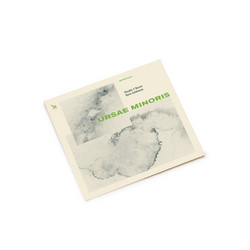
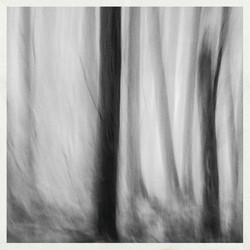
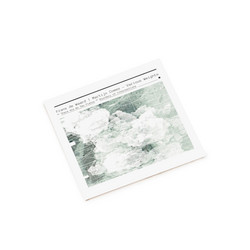
** Edition of 300 ** The Infinite Garden is a project by composer and performer Dario Calderone for four musicians and a live soundscape, conceived as a way to nudge listening beyond the familiar frame of “piece” and “performance” into something more planetary in scope. Rather than treating the outside world as a backdrop to be tamed or filtered, the work invites it in as a co‑author. Structured for four performers and environment, it encourages what Calderone describes as a “global way of listening”: an attitude in which ears move constantly between different spaces and dimensions, from the close friction of bow on string or breath in a reed to the broader textures of passing cars, shifting weather, and the barely perceptible activity of soil and leaves.
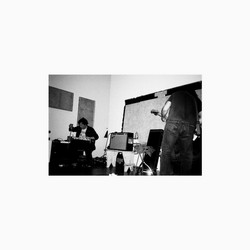
For this recording, made in Amsterdam’s Amstelpark on a cloudy, partially rainy day at the end of January 2025, Aurélie Nyirabikali, Naomi Sato, Gareth Davis and Calderone align their playing with the park’s own unfolding soundscape. The quartet’s instruments move in and out of conversation with the environment: phrases stretch to meet the rhythm of rain, a sustained tone shadows the distant swell of traffic, a fragment of melody rises just as a bird call cuts the air and then leaves space for its echo. Rather than imposing a fixed narrative, the music responds to contingencies - the timing of a passing plane, the sudden hush between gusts of wind, the rustle of a pedestrian cutting across the path. What emerges is not a sealed composition but a live negotiation between intention and chance.
The acknowledgements attached to the project make this ethos explicit. Alongside the four named performers, The Infinite Garden thanks car drivers, pedestrians, birds, raindrops, aeroplanes and radio waves, but also spirits, trees, bushes, ghosts, subtle minds, earthworms, fallen leaves, moles, audience members, foxes, amphibians, water insects, fungi, memories, dreams, intuitions and meteorological events for their contribution to the recording. It is a list that moves freely between concrete entities and inner states, between organisms and weather systems, between the visible and the imagined. The tone is gently playful, yet the implication is serious: whatever we call “music” here is inseparable from a dense web of agents, both human and non‑human, material and mental. The quartet are not sole authors but participants in a much larger field of activity.
In practice, this means the piece behaves more like a garden than a conventional score. Patterns appear, overlap and decay without closing into definitive themes. A line begun by one player may be completed by the environment: a clarinet tone that trails off into the drone of a distant engine, or a breathy figure that merges with the patter of rain on foliage. Silence, too, is porous; it is filled with the microscopic sounds of insects, leaves, damp air and far‑off movement. The musicians’ task is less to dominate this field than to tune themselves to it, allowing their contributions to thicken or thin the texture, to act as flashes of colour or gentle shadows within an already living scene.
The project’s title crystallises this approach. An “infinite garden” suggests a space that is always in flux, never finished, shaped by cycles of growth, decay, intrusion and care. By situating the work in Amstelpark and explicitly crediting the park’s inhabitants and forces as collaborators, Calderone proposes that composition can function as a frame for attention rather than a container for content. The garden extends beyond the boundaries of the recording; what we hear on this particular cloudy January day is one configuration among countless possible ones, each performance and each listen adding further layers of memory and association.