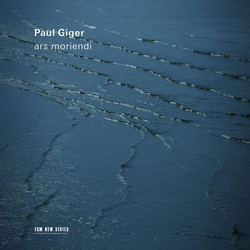
Towards Silence brings together two Swiss musicians, the violinist Paul Giger and the harpsichordist Marie-Louise Dähler, in a programme where Bach alternates with improvisations and pieces they wrote together. It was Giger's sixth album for ECM, following a run of solo and ensemble records that began with Chartres in 1989, and Dähler's first on the label. The title points to the central concern of the record: how a sound leaves silence and returns to it.
Giger plays violin and violino d'amore, Dähler the harpsichord, which in some pieces is prepared or played with unusual techniques. The album was recorded in October 2006 at the Propstei St. Gerold in Austria, with Peter Laenger as engineer and Manfred Eicher as producer. Giger, a former street musician, spent years travelling in Asia, and that experience returns in Bombay II. The booklet has notes by Peter Surber, who writes on Hölderlin and on listening as a spiritual exercise.
The disc opens with a rarely heard low harpsichord D, and From Silence to Silence grows from it before the Aria of the Goldberg Variations enters. The four movements of Bach's Sonata V in F minor, BWV 1018, for violin and obbligato harpsichord, are spread across the programme. Two of them are joined to short improvised preludes or postludes. Cemb a quattro uses a prepared harpsichord, one source of what Gramophone called the album's unusual sounds. The longest piece, the nearly 16-minute Bombay II, revisits Bombay (Good Night) from Giger's 1993 album Schattenwelt and leads into the closing Largo.
Duncan Druce found the new pieces "all extremely evocative, with some amazing, unusual sounds" and called the album "a fascinating, thought-provoking disc". Andreas Obst, in the Frankfurter Allgemeine Zeitung, heard a constant flow from loud to soft, between minimalist undulations and Bachian austerity, improvisation and composition. Rolf Thomas in Jazzthetik stressed the remote acoustic of St. Gerold, where a squeak or a lingering resonance can be followed for a long time before Bach's cascades return. For Ulrich Steinmetzger in the Rheinischer Merkur, Giger never inflates his playing, which makes the duos all the more magical.
CD edition, ECM New Series 2014, first released in August 2007, with a German booklet essay in English translation by J. Bradford Robinson.