Johann Sebastian Bach, Ludwig van Beethoven, Felix Mendelssohn-Bartholdy, Danish String Quartet
Prism IV - Beethoven, Mendelssohn, Bach
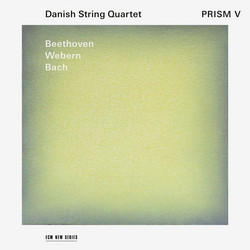
Prism IV is the penultimate volume of the Danish String Quartet's series linking Bach fugues, Beethoven's late quartets and music written in their wake. Ludwig van Beethoven's String Quartet No. 15 in A minor, Op. 132, stands at the centre, introduced by Johann Sebastian Bach's Fugue in G minor from the first book of The Well-Tempered Clavier. For the first time in the series the later work is not from the twentieth century: Felix Mendelssohn's String Quartet No. 2, Op. 13, composed in 1827 within months of Beethoven's death.
The quartet are Frederik Øland and Rune Tonsgaard Sørensen (violins), Asbjørn Nørgaard (viola) and Fredrik Schøyen Sjölin (cello). ECM gives September 2018 and January 2019 as recording dates, at the Reitstadel in Neumarkt, with Markus Heiland engineering and Manfred Eicher producing. The Bach is played in the arrangement by the Viennese composer Emanuel Aloys Förster. In the booklet Paul Griffiths writes that these pieces "sound all the more remarkable for the exquisite brilliance and precision of the Danish players", and the quartet add a note of their own.
Op. 132 opens with a slow, canon-like introduction that looks back to older counterpoint. Its third movement, the Heiliger Dankgesang or holy song of thanksgiving, was written after Beethoven recovered from a severe illness. Here it lasts over eighteen minutes, played with a lean tone and sparing vibrato. A short march leads into the finale, Allegro appassionato. Mendelssohn, eighteen at the time, knew the late quartets and modelled his own closely on Op. 132. He tied its movements together with a motif from his song Ist es wahr?, an answer to the "Muss es sein?" of Beethoven's Op. 135.
In The Guardian, Fiona Maddocks praised a reading of the late work given "with a sense of adventure and freedom rather than weighty reverence". Rebecca Franks of BBC Music Magazine heard the slow movement of Op. 132 echoing in the hymn-like opening of the Mendelssohn, noting simply: "Beethoven was clearly on Mendelssohn's mind." The ECM text recalls that the Prism project had already received a Grammy nomination.
CD edition, ECM New Series 2564, first released in June 2022. The fifth and final volume followed in 2023.