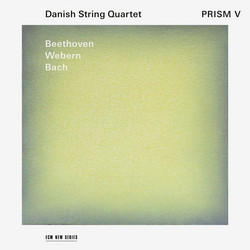
Johann Sebastian Bach, Alfred Schnittke, Ludwig van Beethoven, Danish String Quartet
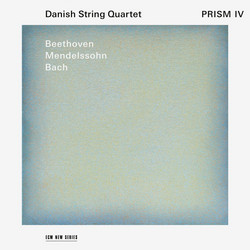
Prism II - Beethoven, Schnittke, Bach
The second volume of the Danish String Quartet's Prism series follows the same plan as the first: a Bach fugue, a modern work and one of Beethoven's late quartets. It arrived a year after the Grammy-nominated Prism I, and this time the links are unusually direct. Alfred Schnittke's Third Quartet quotes the theme of Beethoven's Grosse Fuge, and the disc ends with that fugue in its original place, as the finale of the String Quartet No. 13 in B-flat major, Op. 130.
The quartet is Frederik Øland and Rune Tonsgaard Sørensen (violins), Asbjørn Nørgaard (viola) and Fredrik Schøyen Sjölin (cello). Øland takes the first violin part in the Bach and the Beethoven, Sørensen in the Schnittke. The album was recorded in May 2017 at the Reitstadel in Neumarkt, engineered by Markus Heiland and produced by Manfred Eicher. Paul Griffiths wrote the booklet essay, with notes by the players. In their words, "a beam of music is split through Beethoven's prism".
The opening is the B minor Fugue, BWV 869, which closes Book I of The Well-Tempered Clavier and uses all twelve notes in its subject. It is heard in the string arrangement by Emanuel Aloys Förster, a Viennese contemporary of Beethoven, played with a pure, almost viol-like tone. Schnittke's Third Quartet (1983) begins with a cadence from Lassus's Stabat Mater and also draws on Shostakovich's DSCH motif. Its Agitato is sharp and violent, while the closing Pesante mixes raw weight with gentleness. Op. 130 then runs through five contrasting movements, among them the Alla danza tedesca and the Cavatina. The Grosse Fuge follows, the ending Beethoven's publisher later persuaded him to replace.
In The New York Times, David Allen wrote that "no quartet playing today has the Danish's way with late Beethoven", pointing to the Cavatina. Tim Homfray in The Strad (2019) heard the fugue in "vivid, propulsive playing, sometimes granitic, at others pliant". James Manheim of AllMusic argued that after a Beethoven this intense nothing could follow, which is why the quartet puts it last rather than in the middle.
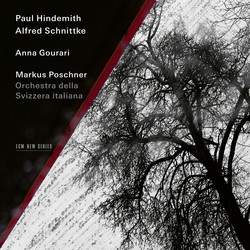
This is the CD edition, ECM New Series 2562, first released on 13 September 2019.