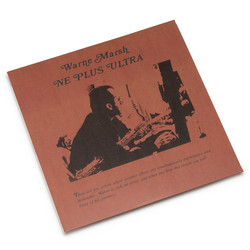
**2026 stock** Cut at Sound Studios in Chicago on February 20, 1976, All Music brings Warne Marsh into the studio with pianist Lou Levy, bassist Fred Atwood and drummer Jake Hanna for a quartet date that quietly reframes his New York legacy. Before the session, Marsh announced that he wanted to record one tune each by Lennie Tristano, Lee Konitz and himself from his New York days - a compact manifesto of allegiance and independence. The result is an album that feels at once like a homecoming and a fresh departure: the harmonic mazes and asymmetrical phrases of the Tristano school are all here, but the atmosphere is loose, swinging and unforced, closer to a conversation among equals than a historical reenactment.
The core program balances those three compositional poles, allowing Marsh to trace the lines between his mentors and his own developing voice. Tristano’s writing brings the characteristic layered harmony and long-breathed melodies that Marsh navigates with relaxed precision; Konitz’s contribution folds in a slightly different contour and lyricism; Marsh’s own tune completes the triangle, showing how he has absorbed and re-angled those ideas over time. Throughout, Levy supplies a supple, harmonically alert backdrop, comping with a light but decisive touch and soloing in lines that mirror Marsh’s clarity without imitation. Atwood’s bass and Hanna’s drums keep the ground buoyant and propulsive rather than aggressive, giving the music the kind of understated lift that lets Marsh’s lines really breathe.
Issued originally on Nessa, All Music has since become a key waypoint in Marsh’s discography, marking what many listeners hear as a period of renewal: the lines as intricate as ever, but looser, more playful, less beholden to textbook cool. For this CD reissue, six alternate takes and one previously unissued track have been added, opening a window onto the band’s process. You hear themes approached from slightly different angles, Marsh testing rhythmic emphases or phrasing options, the rhythm section adjusting shading and dynamic focus. Far from mere bonus material, these alternates underline how alive the underlying conception is - how much freedom is built into the architecture.
Taken together, the original album and expanded reissue present All Music as more than a mid-’70s footnote. It’s a compact statement of principles: a Tristano-line tenor, decades in, sounding liberated rather than nostalgic; a quartet that respects the intricacies of the material without becoming precious; and a reminder that “cool” jazz, in the right hands, can be as quietly radical as anything in the avant-garde.