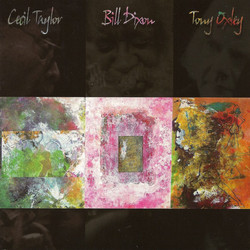
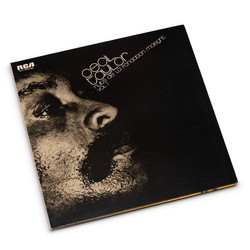
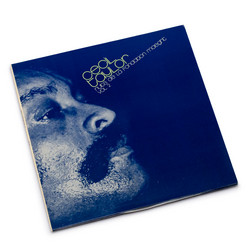
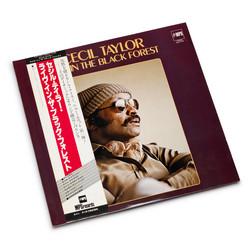
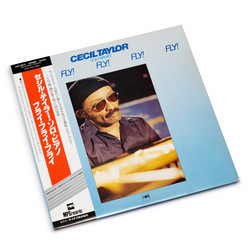
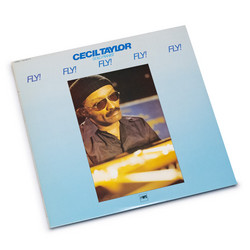
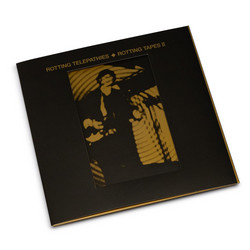
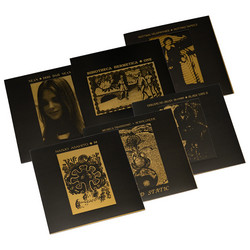
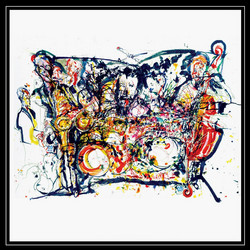
** Heavy tip-on 2LP gatefold jacket with ink pigment and metallic foil stamping on uncoated paper, metallic spot color gatefold. Detailed, color printed 12-page listening guide. ** Black Editions Archives presents Live at the KiMo Theater Albuquerque 1979, a major new archival work by the late Cecil Taylor (1929-2018). Pianist, composer & bandleader Cecil Taylor's capacious & audacious originality reshaped twentieth-century music. In an astounding act of artistic forbearance spanning sixty years of performing & recording, Taylor didn't win over so much as wear down the jazz establishment through the force & brilliant execution of his ideas. His methodologies & language, if studied at all, remain unassimilated by the twenty-first century jazz mainstream & its institutions.
Lincoln Center turned the house lights on during Taylor's first performance there (2007), a stark reminder that in spite of Guggenheim & MacArthur Fellowships & increased respect among some of his tradition-minded peers, the shock of his music had not diminished & he was still an outlier, if not an outlaw, presence. Live at the KiMo Theater Albuquerque 1979 captures Taylor on November 20, 1979, during a rare tour of the American West with a then newly reconstituted quintet formation of his Unit. An ensemble in regular flux from the mid-1970s onward, only two members of Taylor's 1978 Unit, violinist Ramsey Ameen (1945-2019) & alto saxophonist Jimmy Lyons (1931-1986) -- the bel canto voice of every Cecil Taylor band since 1961-- made the trip with Taylor to Albuquerque. Re-entering the fold on bass & cello after a decade-long absence was prime mover extraordinaire Alan Silva (1939-), with drummer Jerome Cooper (1946-2015) making his Cecil Taylor Unit performance debut. Each historical incarnation of the Cecil Taylor Unit emphasized the musicians' freedom to infuse the architectures of Taylor's music with their own personalities.
Together with the Maestro in Albuquerque, this novel formation played a concert as unique & fascinating as its line-up & instrumentation suggests, with dynamics, textures, & interactions that are quite different from the often in-the-red, sometimes gladiatorial 1978 Taylor bands. The addition of Sunny Murray to this ensemble in February 1980 for the recording of It Is In The Brewing Luminous (HatHut) would transform the music yet again. KUNM & New Mexico Symphony recording engineer Mike Wolff created a custom bandshell for the ensemble on the stage of the historic KiMo Theater, utilizing direct & indirect symphonic miking to capture the music for NPR's Jazz Alive program. Jazz Alive never broadcast the recording, and the tapes lay dormant for 40 years, until Tom Guralnick -- producer of the 1979 concert & director of the Outpost Performance Space (Albuquerque) -- brought the recording to the attention of Black Editions Archive.
Released in direct cooperation with Guralnick, with the permission of the musicians of the 1979 Cecil Taylor Unit & their heirs, Live at the KiMo Theater Albuquerque 1979 is presented in a x2LP heavy tip-on gatefold jacket featuring ink pigment & metallic foil stamping as well as an illuminating & historically detailed 12-page listening guide by Taylor scholar Ben Young. Kevin Gray at Cohearent Audio cut the lacquers & Fidelity Record Pressing struck the audiophile-quality vinyl. This stellar production chain in combination with Wolff's symphonic recording approach has resulted in the most dynamic & natural sounding live recording in Cecil Taylor's discography. Listening to the music of Cecil Taylor is perhaps an even more radical act in 2026 than at any other time in the last half century. With Live at the KiMo Theater Albuquerque 1979, Black Editions Archive proudly puts its shoulder into growing & enhancing Taylor's legacy." - Michael Ehlers