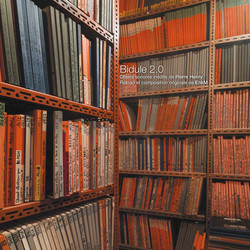
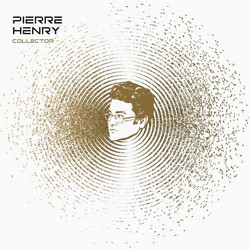
Bidule 2.0 is neither tribute album nor simple remix; it is a meticulous act of archaeological fiction. Built from unreleased sound objects by Pierre Henry, reloaded and recomposed by eRikm, the record opens a seldom‑seen door onto the Son/Ré studio archives and then walks straight through it into another era. Rather than touching Henry’s iconic, already‑canonical materials, eRikm chooses to work with what had remained in the wings: unused recording sessions spanning 1950 to 1974, digitised by the Bibliothèque nationale de France. Prepared piano flurries, series of electronic tones, feedback studies, disembodied voices - 168 analog sequences between one and twenty‑two minutes long, supplied by Isabelle Warnier and Bernadette Mangin - become the primary clay for a new, resolutely contemporary composition.
Those tapes carry with them a very specific acoustic fingerprint. They are documents of technique as much as of imagination: the grain of mid‑century microphones, the limitations and colouration of the recording media, the reverberant signatures of particular rooms, the noise floor of machines running and rewinding. All of this “defines the sound of a time,” and Bidule 2.0 takes that definition seriously. Where a conventional restoration might aim to clean such traces away, eRikm treats them as structural features. The analog hiss, the slight wow and flutter, the air around sources become active elements in his new work, markers of distance and materiality that hold Henry’s presence inside the composition even when the original gestures are heavily transformed.
The transformation chain is radical. Pierre Henry’s sounds are passed through multiple generations of digital processing - “up to five generations of transformation” - via a custom electronic device, Idiosyncrasie 9.3, designed and built by eRikm in a Max/MSP and Lemur environment. This bespoke instrument allows him to treat the archive as a live, unstable body: slicing, granulating, re‑pitching, filtering and recombining source fragments in ways that echo Henry’s own tape‑based manipulations while decisively belonging to another technological regime. Fixed compositional decisions and unexpected sonic events are deliberately balanced. Structures are shaped in advance, yet within them Idiosyncrasie 9.3 is allowed room to misbehave, to produce happy accidents, glitches and aleatoric swerves that keep the music hovering between control and surprise.
The resulting piece is less a collage than a long, mutating organism. Motifs surface - a cluster of prepared piano hits, a rising electronic whine, a breath that might once have been part of a spoken phrase - and then are swallowed, inverted or set spinning in new orbits. At times, the density recalls the classic works of musique concrète: tightly packed events, sudden cuts, vertiginous changes of scale. Elsewhere, the sound opens into more spacious, spectral zones where a single, attenuated gesture - a feedback tone slowly modulated, a voice disintegrating into sibilants - is allowed to occupy the frame. Throughout, the listener remains aware of two temporalities running in parallel: the mid‑20th‑century sessions with their specific studio aura, and the contemporary digital processing that fractures and recombines them according to a very different logic.
What makes Bidule 2.0 compelling is precisely this convergence of historical archive and present‑tense invention. eRikm refuses nostalgia; his aim is not to imagine “what Henry would have done with today’s tools,” but to create a situation in which Henry’s unused sounds can act again, in a new context, with new stakes. In doing so, he also points to the broader question of how electroacoustic heritage can be kept alive: not simply preserved as inert documents, but reactivated as material for further research and composition. The title’s playful “2.0” hints at this versioning: the bidule - the “thingamajig,” the device, the apparatus - updated not as software, but as a relationship between generations of practice.
Produced by CNCM/La Muse en Circuit (Alfortville) and INA/GRM (Paris), with co‑production from CNCM/GMEM in Marseille, the project sits firmly within the French institutions that have long shaped the trajectory of electroacoustic music, while gently troubling any neat lineage those institutions might claim. Mastering by Frédéric Alstadt at Angstrom Mastering preserves the full dynamic and spectral complexity of eRikm’s transformations, giving weight to the low‑level details and ensuring that the most fragile archival ghosts remain audible inside the new, high‑definition frame. The result is a singular sonic experience: a composition that listens intently to a past era’s experiments even as it subjects them to the restless, probing intelligence of the present.